AI-NATIVE SERIES · LEARNABLE HOPE, PART 2 OF 5
Hope Starts in the Body: Shake, Bounce, Rotate, Oscillate (SBRO) and Martial-Arts Training for the First Four Weeks
1-minute takeaway
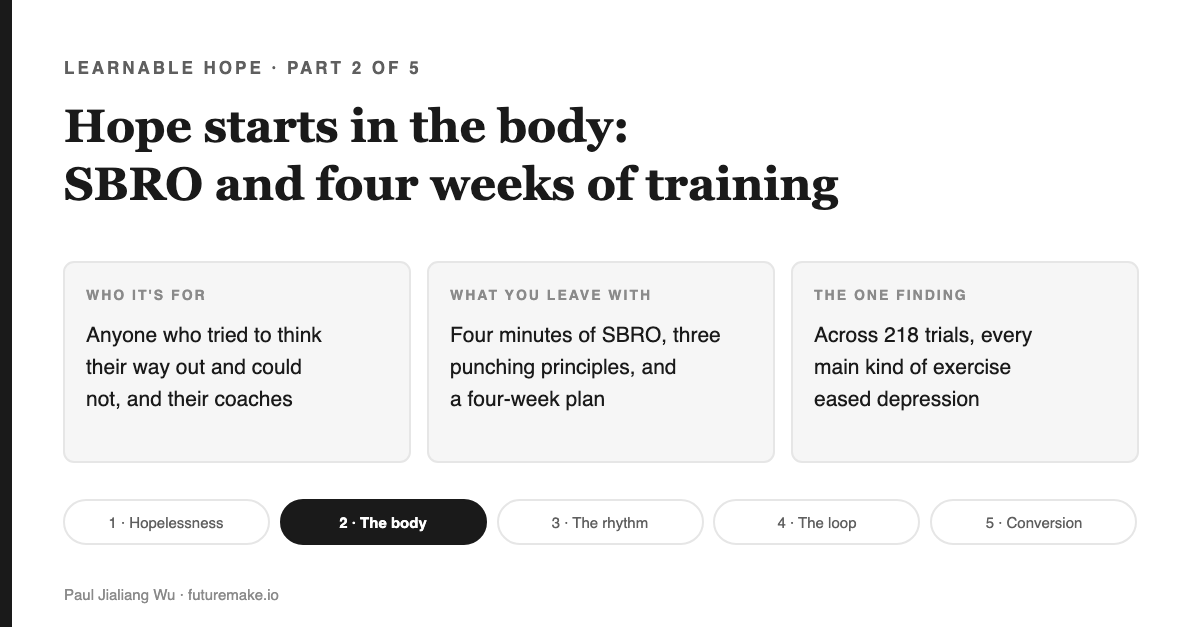
What this is. Part 2 of five. It explains why the body is the cheapest place to experience control, gives SBRO (shake, bounce, rotate, oscillate) with two clips from my 2022 live session, three physical principles, and a four-week plan.
Why it matters. Across 218 trials, walking, yoga and strength training each reduced depression with moderate effects, and harder sessions did more, on low-certainty evidence. No trial has tested MMA for depression, and repeated head impacts carry real brain risk. Getting both facts right is the difference between a training plan and a hazard.
What you can do after reading. Do four minutes of SBRO today, then follow the four weeks: shadow rounds, pads with no head contact, then strength. Log sessions, effort and hope, and use the five stop rules.
Learnable Hope — the series spine
▶ See it running: open the live demo public · no sign-in
- Hopelessness — giving up is the default, hope is what gets learned episode 1
- The body — SBRO and MMA-style training, four weeks this episode
- The rhythm — maximise calling, minimise cost episode 3
- The loop — observe, evaluate, control episode 4
- The conversion — pain into calling, and the members' track episode 5
Why should hope start in the body, and what exactly do you do in the first four weeks?
This piece does not answer: What was learned when hope was lost, and the evidence that control can be learned — that is part 1. How hard to push once you are moving, and how to count what it costs — that is part 3. How to read your numbers each week and change one thing — that is part 4. What all of this turns into, and the members' track — that is part 5.
How to read the labels: EVIDENCE is sourced, TALK is what I said in a recorded talk (linked to the second), DESIGN is how the method is built, OPEN is not yet tested, and LENS is my own conviction.
A note before we start: I am an engineer and a recreational martial artist, not a clinician or a licensed coach. This is a training method, not a treatment, and not medical advice. Check with a doctor before starting hard exercise, especially if you have a heart condition, are pregnant or have been inactive for a long time. Verses are quoted from the World English Bible (WEB), public domain.
What this part covers: four warm-up moves (SBRO), and why the body goes first
Part 1 ended on a root cause: a stuck person is missing a repeated experience of control. This part answers where to get that experience fastest. My answer, from my own year and from fifteen hours of talks, is the body. Not because the mind does not matter, but because the body is the place where "I did something and it worked" is easiest to see.
It is for anyone who has tried to think their way out and could not, and for the friend or coach who wants something concrete to do with them on Monday. You leave with SBRO (shake, bounce, rotate, oscillate), three physical principles I teach in every martial arts class (mostly in the style of MMA, mixed martial arts, without the head contact), the honest evidence for each, and a four-week plan that starts at five minutes a day.
The picture: the warm-up before class
Walk into any good martial arts gym ten minutes before class. Nobody is sparring. People are shaking out their arms, bouncing on their toes, turning their hips, rocking from foot to foot. The coach is not teaching anything yet. The bodies are being told: you are here, you can move, the next hour is safe enough to try things.
| In the gym | In the method |
|---|---|
| Shaking out the arms | Shake: release tension you can feel |
| Bouncing on the toes | Bounce: rhythm, and a heart rate that rises on purpose |
| Turning the hips | Rotate: the body moves as one piece |
| Rocking foot to foot | Oscillate: left and right taking turns |
| Ten minutes before the first drill | The first week of training, before any "real" work |
| The coach watching, not correcting | Feedback starts after the body is warm |
Where the picture breaks: a gym member chose to come. On a bad day a depressed person may not be able to stand up. Then SBRO is done sitting, or not at all that day, and that still counts as a day you showed up to the sheet.
The order of care is old
LENS The oldest account I know of a man who wanted to die is about Elijah, and what happens next is not a sermon. He sleeps. He is told to eat. He sleeps again. He is told to eat again, because the journey is too long. Only then does he walk.
He lay down and slept under a juniper tree; and behold, an angel touched him, and said to him, “Arise and eat!” He looked, and behold, there was at his head a cake baked on the coals, and a jar of water. He ate and drank, and lay down again. Yahweh’s angel came again the second time, and touched him, and said, “Arise and eat, because the journey is too great for you.” He arose, and ate and drank, and went in the strength of that food forty days and forty nights to Horeb, God’s Mountain.
— 1 Kings 19:5-8 (WEB, World English Bible)
I read the sequence (sleep, food, then the walk, then the quiet voice) as an order of care, and I keep it. Isaiah 35 speaks to the despairing in the same bodily images, weak hands and feeble knees, before it speaks to the fearful heart, and it rests their strength on God's coming, not on their effort.
Strengthen the weak hands, and make firm the feeble knees. Tell those who have a fearful heart, “Be strong. Don’t be afraid. Behold, your God will come with vengeance, God’s retribution. He will come and save you.
— Isaiah 35:3-4 (WEB, World English Bible)
What the evidence says about moving
EVIDENCE A network meta-analysis of 218 randomised trials and 14,170 people with major depression found that every main kind of exercise helped. Of the main kinds, walking or jogging had the largest effect and tai chi the smallest (dance scored higher, on five small studies; see below), and strength training and yoga were the easiest to keep doing (Noetel et al., BMJ 2024). For the record, against active controls: walking or jogging g = −0.62, yoga −0.55, strength training −0.49, mixed aerobic exercise −0.43, tai chi or qigong −0.42, where g is a standardised effect size and a bigger minus means depression scores fell more. The same paper found a dose-response for intensity: vigorous exercise g = −0.74 against −0.58 for light (full text). The caution is in the same abstract: confidence was low for walking and very low for the rest, and only one study met the criteria for low risk of bias.
EVIDENCE Supervision may help. An earlier meta-analysis found larger effects in trials where exercise was moderate to vigorous and led by exercise professionals (Schuch et al., 2016); that is a comparison between trials, not a test of supervision itself. And the authors of the BMJ review describe exercise as something to use "alongside psychotherapy and antidepressants", not instead of them (Noetel et al., 2024).
EVIDENCE For martial arts specifically, a meta-analysis of 14 studies found an effect on wellbeing of d = 0.35 and on internalising problems such as anxiety and low mood of d = 0.62 (here a positive number means better), the second with a confidence interval that nearly touches zero and high variation between studies (Moore et al., 2020). Non-contact boxing programmes, usually group pad work, report reductions in anxiety and depression, as "preliminary evidence" (Bozdarov et al., 2023). OPEN No randomised trial has tested MMA for depression. I do not claim one.
EVIDENCE And the safety line that shapes everything below: repeated blows to the head are linked to a brain disease called chronic traumatic encephalopathy (CTE), which can damage memory, self-control and mental health (review, 2024). So for anyone training their way out of depression: no head contact. Ever.
SBRO, honestly
TALK In a 2022 live session I opened with the simplest thing I know: "the less you take you take yourself less serious the more fun you have That's My Philosophy" (LIVE Demo 4, 06:09). Then we shook.
DESIGN The four movements, one minute each:
- Shake. Shoulders loose, arms shaking out in front, then to the sides.
- Bounce. Small springs on the balls of the feet, the body like a pole, hands alternating forward and back.
- Rotate. Turn the hips and shoulders together, left and right, letting the arms swing.
- Oscillate. Rock weight from foot to foot, then add a slow left-right punch in the air, one hand out while the other returns.
OPEN Here is what the evidence does not say. No trial has tested SBRO. The closest studies are weak: one small trial of a "shaking" exercise method (TRE) found no difference on its main outcome before statistical adjustment, and it was in people with multiple sclerosis, not depression (Skovgaard et al., 2025); a rocking-chair study in veterans was a feasibility test with no depression outcome (Cross et al., 2018). Dance had the largest point estimate in the BMJ review, g = −0.96, from five small studies that the authors declined to recommend strongly. LENS So I teach SBRO as a warm-up and a door, not as a therapy: it is fun, it gets the heart rate up, it gives you four reps you can win in four minutes, and it leads into the work that has better evidence.
Three physical principles
TALK In the same session I gave three principles for every punch, and recapped them in under a minute (LIVE Demo 4, 50:18): left and right always coordinate, one hand going out while the other comes back; control the part close to your core, the elbow, not the fist; and "use your imagination to create a target".
EVIDENCE The third one has good evidence for learning movement, which I did not know when I taught it. Across 73 studies, focusing on an external effect (where the movement goes) rather than on your own body parts improved performance (g = 0.26, 95% CI 0.22–0.31); it also improved retention (g = 0.58, 0.43–0.74) and, across 40 studies, transfer to new situations (g = 0.58, 0.33–0.84) (Chua, Wulf et al., 2021). These studies measured movement learning, not mood. LENS An imagined target is close to what they call an external focus. A future you can picture is the same move at the scale of a life, which is part 4.
Five whys
Why should hope start in the body rather than in a better thought?
- Because a better thought rarely survives a bad morning. The explanation "me, always, everywhere" formed through experience, and argument alone rarely edits it.
- Because action moves mood about as much as talking does. Activity scheduling showed no detectable difference from cognitive therapy (10 studies, difference 0.02) (Cuijpers et al., 2007), and in the 2026 Cochrane review exercise and psychological therapy differed by a standardised 0.03 (95% CI −0.16 to 0.23, moderate certainty) (Cochrane, 2026).
- Because the body gives the fastest visible proof of control. A rep is done or not done; a heart rate goes up when you bounce. That is the kind of plain, visible success the animal work on control points to (Amat et al., 2005).
- Because a depleted system needs input before it can do work. A body is an open system that runs down without sleep, food and movement; Elijah was fed twice before he walked.
- Root cause: the body is where controllability is cheapest to experience. Start there, and let the thinking follow the evidence your own body produces.
Operate
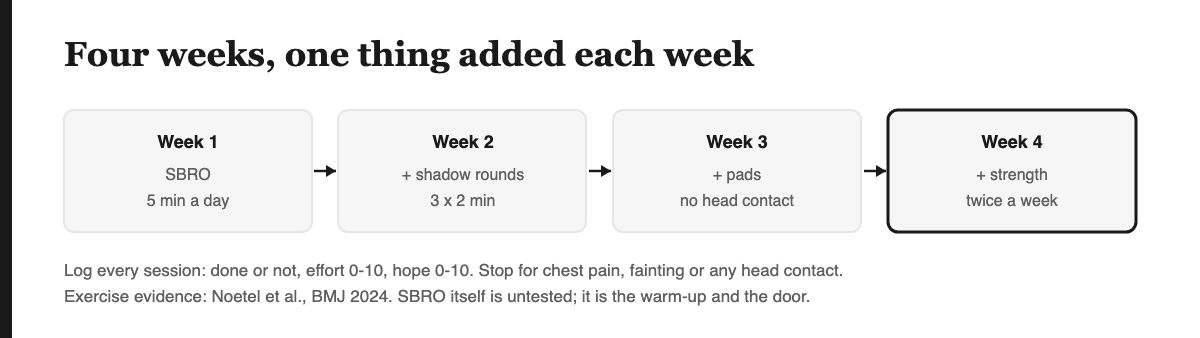
DESIGN Four weeks, each one adding a single thing. Log every session on the same sheet as part 1: what you did, done or not, effort from 0 to 10, and the hope number.
- Week 1. SBRO, five minutes a day. Shake, bounce, rotate, oscillate, one minute each, plus one minute of the slowest punches you can do.
- Week 2. Add shadow rounds three times a week. Three rounds of two minutes, one minute rest: punch the air at an imagined target, left and right coordinated, elbow-led.
- Week 3. Add pads with a partner or a coach. Non-contact pad work, the partner holds, nobody strikes the head. If no partner, a heavy bag.
- Week 4. Add strength twice a week. Push-ups, squats and rows at a level where the last two reps are hard. Strength training and yoga had the lowest dropout in the BMJ review.
Feedback
What you measure: sessions done per week against the plan, average effort, and the hope number's weekly average. OPEN My bar for the four weeks is 80% of planned sessions and an effort that rises from about 3 to about 6 out of 10.
What it cannot see: whether the change is the training or the season, sleep, a new job or a new friend. It cannot see injuries that are developing slowly. And it cannot tell you that you are well; only a clinician can assess that.
Feedforward
Feedforward means acting before any error appears: on a plan, or on a disturbance you can see coming. Then come the tripwires below it: they are feedback rules, firing on something you observe (a number or an event), written in advance so a bad day cannot argue with them. They are reviewed after the first cohort, on 2027-03-15.
Seen coming. Weather, travel, a late shift, the week a cold usually catches you. Before the week starts, decide the fallback for each: SBRO in a hotel room, shadow rounds in a hallway, a walk instead of pads.
DESIGN Tripwires (stop rules), decided before week 1:
- Chest pain, fainting, or breathlessness out of proportion: stop and see a doctor before the next session.
- Any head contact in pad work: that partner or gym is wrong for this programme; leave.
- A joint that hurts more the next morning: swap that day's work for a walk, and keep the log.
- Two weeks under 50% of sessions: go back to week 1. Five minutes a day is a full win.
- Any thought of harming yourself: call 988 (US) or your local emergency number. Training waits.
Laws and fashions
A law (★) is a claim that three or more independent research groups reach; a fact rests on one or two; a fashion is a dated item expected to change (a recent study, official guidance, a tool, or my own untested practice). Physics is cited as physics. Scripture is quoted as conviction, labelled LENS, and never counted as evidence.
- ★ Exercise reduces depressive symptoms by a moderate amount, across independent review lines: Cochrane, 2026 (with Cooney et al., 2014 from the same review line), Noetel et al., 2024, and Schuch et al., 2016, whose estimate is the largest. The effect is smaller in the best-designed trials (Cochrane; Noetel). Out of date if large careful trials find no effect.
- Fact (two sources): for moderate or severe depression, exercise is an addition to treatment, not a replacement: the WHO fact sheet puts psychological treatment first, and Noetel et al. describe exercise as something to use alongside psychotherapy and antidepressants. Out of date if guidelines list exercise alone as a first treatment for moderate or severe depression.
- Fashions: SBRO itself (my 2022 warm-up, untested); non-contact boxing programmes (2023 scoping review); dance's large estimate from five small studies (2024).
On the mat and in the street
This section is about staying safe, not about expecting danger. If today is heavy, skip to the next one.
- Training: the warm-up is not decoration; it is where a beginner's nervous system learns that the room is safe enough to try.
- Sparring: for this programme there is none in the first four weeks. When it comes later, it is light, with no head contact.
- Competition: not needed for anything in this series.
- The street: after a frightening encounter, many people shake. Walking and shaking out the arms afterwards is ordinary, and it is the same movement you practised.
- An attack: the one body skill I would add for everyone is bleeding control: after the scene is safe and 911 is called, apply direct pressure, pack the wound, and use a tourniquet on a limb if bleeding continues (American College of Surgeons). Classes are listed at stopthebleed.org.
Try it today
Four minutes, four reps
- Stand up, or sit if standing is too much today.
- One minute each: shake, bounce, rotate, oscillate. Watch the two clips above first if it helps.
- Finish with ten slow punches at an imagined target, left and right taking turns.
- Write: date, done, effort 0–10, hope 0–10.
- Do the same tomorrow. In week 2, add the shadow rounds. :::
TRUE
The last two sections are my own check on this article: how it could be proved wrong, and how well I think it did.
- Transferable. Body first, then thinking, works for exam panic, grief and burnout. It transforms "talk them through it" into "move with them first, then talk".
- Recursive. This part is wrong if people who complete four weeks show no greater rise in their hope number than people who only keep the log from part 1. I will compare the two groups in the first members' cohort and re-read this part on 2027-04-01.
- Understandable. Your body is the quickest place to feel "I did that and it worked", so start there, five minutes a day. The Theory U move (the inner move this part asks of you; see part 1) is let go: stop waiting to feel ready before you move.
- Experience it. Watch the two clips and do four minutes now; the full session is LIVE Demo 4 on GodPlay, and the channel is youtube.com/@godplaylab. It would prove me wrong if four weeks of logged sessions left your effort and hope numbers flat.
- Built. The four-week plan is module 2 of the members' track in part 5.
- Taught. Teach SBRO to one person this week, with their consent, and write down which of the four they liked best.
5S self-score
| S | Self-score | Evidence |
|---|---|---|
| Simple | 5/5 | four words, four minutes, and two clips that show them |
| Solid | 3/5 | exercise has trial evidence; SBRO itself has none, and the section says so in its own paragraph |
| Sharp | 4/5 | the five whys end at a mechanism: the body is the cheapest place to experience control |
| SMART | 4/5 | four weeks, a numeric bar (80% of sessions), five stop rules |
| Super-fun | 4/5 | shaking and bouncing in a room by yourself is hard to do with a straight face |
Sources
- Noetel et al. (2024), exercise for depression, network meta-analysis, BMJ 384:e075847. https://europepmc.org/article/MED/38355154 (full text https://europepmc.org/article/PMC/PMC10870815)
- Schuch et al. (2016), exercise for depression, J Psychiatr Res 77:42–51. https://europepmc.org/article/MED/26978184
- Cochrane review, "Exercise for depression" (2026). https://europepmc.org/article/MED/41500513
- Cuijpers, van Straten & Warmerdam (2007), activity scheduling. https://europepmc.org/article/MED/17184887
- Moore, Dudley & Woodcock (2020), martial arts and mental health, J Bodyw Mov Ther 24:402–412. https://europepmc.org/article/MED/33218541
- Bozdarov et al. (2023), non-contact boxing, scoping review. https://europepmc.org/article/MED/37426738
- Head impacts and chronic traumatic encephalopathy, systematic review (2024). https://europepmc.org/article/PMC/PMC11623818
- Skovgaard et al. (2025), TRE randomised trial. https://europepmc.org/article/MED/40064004
- Cross et al. (2018), rocking-chair feasibility study. https://europepmc.org/article/MED/29224460
- Chua, Jimenez-Diaz, Lewthwaite, Kim & Wulf (2021), external focus meta-analyses, Psychological Bulletin 147:618–645. https://oasis.library.unlv.edu/kns_fac_articles/424
- Amat et al. (2005), the medial prefrontal cortex detects control. https://europepmc.org/article/MED/15696163
- American College of Surgeons, Stop the Bleed. https://www.facs.org/for-medical-professionals/news-publications/news-and-articles/press-releases/2024/learn-how-to-save-a-life-with-3-steps-during-national-stop-the-bleed-month/
- My talk: LIVE Demo 4, GodPlay (2022). https://www.youtube.com/watch?v=LHOoUPnICl8
Where this part sits in the series
| Conception | Core concept | Governing principle | Main contributors | |
|---|---|---|---|---|
| Hopelessness (part 1) | Psalm 42 → Seligman & Maier (1967) → Abramson et al. (1978) → Maier & Seligman (2016) | giving up is the default; hope is the learned skill | supply a small, visible experience of control, daily | Martin Seligman · Steven Maier · Lyn Abramson · C. R. Snyder · Pim Cuijpers |
| The body (this part) | 1 Kings 19 → Isaiah 35 → behavioural activation (2007) → the BMJ network meta-analysis (2024) | the body is the cheapest place to experience control | body first, no head contact, add one thing a week | Michael Noetel · Felipe Schuch · Gabriele Wulf · Ian Moore |
| The rhythm (part 3) | Hebrews 12 → progressive overload (ACSM, 2009) → MMA injury meta-analysis (2014) → instrumented mouthguards (2021) | calling and cost held in one designed rhythm | oscillate on purpose; the cost side gets the first vote | Reidar Lystad · the ACSM · Gabriele Wulf · DHS and Counter Terrorism Policing |
| The loop (part 4) | Watt's governor → Wiener (1948) → Boyd's OODA sketch (1995) → Åström & Murray (2008) | feedforward plus feedback at every time scale | a fixed time, a fixed bar, one change, one outside reader | John Boyd · Karl Åström · Richard Murray · Arne Nieuwenhuys |
| Conversion (part 5) | Romans 5 → Noether (1918) → Landauer (1961) → Amat et al. (2006) | pain is not conserved, but it can be converted | conversion needs a process, an input and someone to teach | Emmy Noether · Rolf Landauer · José Amat · the Left Write Hook team |