AI-NATIVE SERIES · LEARNABLE HOPE, PART 1 OF 5
Depression as Acquired Hopelessness: Giving Up Is the Default, Hope Is What Gets Learned
1-minute takeaway
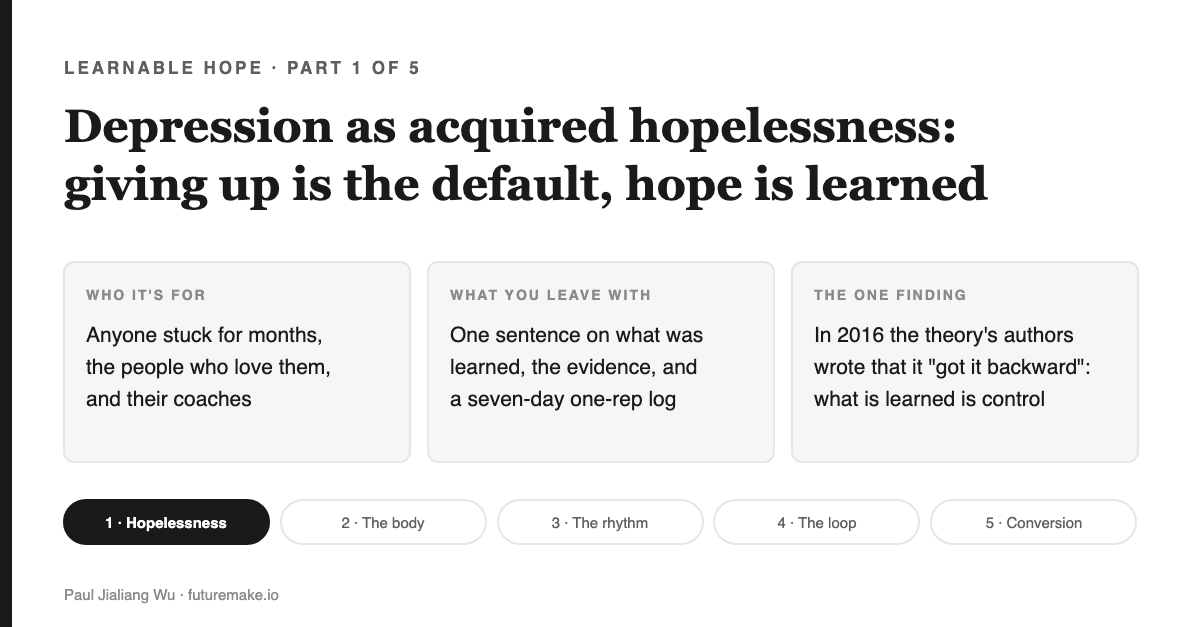
What this is. Part 1 of five on Learnable Hope, a training method I built from my own depression in 2000 and 2001 and fifteen hours of recorded talks. It explains what is actually learned when a person loses hope, and why the reverse can be trained.
Why it matters. In 2016 the scientists who named learned helplessness wrote that their original theory "got it backward": passivity is the default, and control is what is learned. If that holds for people, the most useful thing you can offer someone stuck is not an argument but one small action that visibly works.
What you can do after reading. Start the seven-day one-rep log today: one action under two minutes that you control, done or not, and a hope number from 0 to 10. Four tripwires, including when to call a doctor or 988, are written before day one.
Learnable Hope — the series spine
▶ See it running: open the live demo public · no sign-in
- Hopelessness — giving up is the default, hope is what gets learned this episode
- The body — SBRO and MMA-style training, four weeks episode 2
- The rhythm — maximise calling, minimise cost episode 3
- The loop — observe, evaluate, control episode 4
- The conversion — pain into calling, and the members' track episode 5
If depression is acquired hopelessness, what exactly was acquired, and why can hope be learned?
This piece does not answer: What to do with your body on day one, and why the body goes first — that is part 2. How to push toward a calling without paying for it in injuries — that is part 3. How to tell, week by week, whether any of it is working — that is part 4. What the lost year can become, and where this turns into practice with others — that is part 5.
How to read the labels: EVIDENCE is sourced, TALK is what I said in a recorded talk (linked to the second), DESIGN is how the method is built, OPEN is not yet tested, and LENS is my own conviction.
A note before we start: I am an engineer who went through a long depression and came out of it, not a clinician. This series is a training method, not a treatment, and nothing here is medical advice. If you take medication or see a counsellor, keep doing so and train alongside them. Where a study is small or only shows a correlation, I say so. Verses are quoted from the World English Bible (WEB), which is public domain, as bible-api.com returns them.
What this part covers: hopelessness, and who it is for
Between 2021 and 2023 I recorded about fifteen hours of talks on my channel, now called GodPlay (youtube.com/@godplaylab), about the year depression nearly ended me and what got me out. This series compresses those hours into five parts, checks every claim against the research, and turns what survives into training you can start this week.
This first part is for three people: the one who has been stuck so long that "try harder" sounds like an insult; the one who loves them and does not know what to say; and the coach, pastor or friend who wants a model better than "cheer up". You leave with one sentence that explains what was learned, the evidence for why hope can be learned back, and a seven-day log that starts the reversal with one controllable rep a day.
My titles back then promised to beat depression "in days". I would not write that sentence today, and this series does not. What I can say is narrower and, I think, more useful: hope behaves like a skill, skills are trained, and training starts with something you can control.
If you are not in the US. The crisis box at the top gives the US line. Elsewhere:
| Where you are | Who to contact |
|---|---|
| United States | 988, the Suicide & Crisis Lifeline (988lifeline.org; in Chinese it is voice only, ask for Mandarin or Cantonese) |
| Canada | 988, the Suicide Crisis Helpline (988.ca) |
| UK and Ireland | 116 123, Samaritans (samaritans.org) |
| European Union | 112, emergency services (police, ambulance) in every EU country (European Commission) |
| Anywhere else | findahelpline.com lists free lines by country |
The picture: the fighter who stopped defending
Picture a fighter in the third round who has stopped putting their hands up.
Nobody taught them to drop their guard. They took round after round of shots they could not see coming and could not stop, and somewhere in round two the body concluded that defending was pointless. Now even an easy jab lands, because the hands no longer move. Then a coach in the corner does something simple: one slow drill, one block that works, five times. The hands come back up, a little.
| On the mat | In the research |
|---|---|
| Rounds of shots you cannot see or stop | Uncontrollable aversive events (bad things you can't stop) |
| Hands dropping | Passivity: the default response to pain you cannot escape |
| One block that works, felt in the body | The brain noticing "that worked" (in animals, the medial prefrontal cortex) |
| "You're not a fighter, you never were" | Explanatory style: the cause is me, forever, everywhere (this is the part that is acquired) |
| Getting back on the mat for one round | Behavioural activation: act first, feel later |
| A fighter who expects to find a way | Hope: goals, pathways and agency |
Where the picture breaks: a fighter chose to step into the ring. Nobody chooses depression, and nobody who is depressed is a coward. The picture is about mechanism, never about blame.
My year
TALK In 2000 and 2001 I lived inside it for more than a year. In a talk I described the bottom plainly: "by then the biggest thing for me is the biggest dream for me is how can I eat like a normal person" (Win Depression part 3, 47:36). I lost my memory for words, my sleep and my ability to talk to people, and I had thoughts of not wanting to live. I tried everything a sensible person tries. None of it moved.
TALK What turned first was not my mood. It was one sentence I chose to hold while I still felt like nothing: "jesus is my future i don't care how other people look at me" (Part 1b, 34:52). Then came small things I could actually do: a few push-ups, a two-minute task, a thank-you said out loud. Twenty years later I can describe the mechanism better than I could live it.
What was learned: the 2016 correction
The phrase "learned helplessness" comes from a 1967 experiment: dogs that had received shocks they could not escape later failed to escape shocks they could (Seligman & Maier, 1967). For fifty years the story was that the animals learned helplessness.
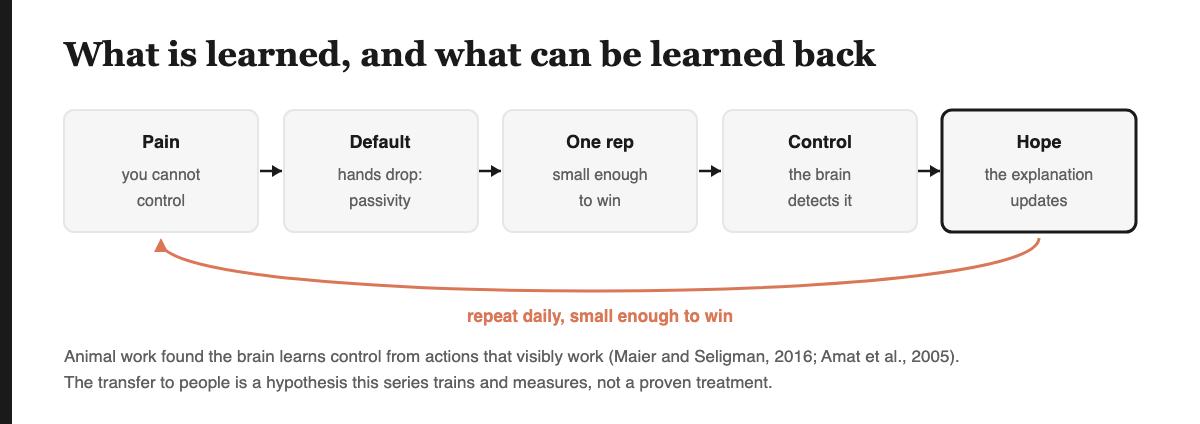
EVIDENCE In 2016 the same two researchers published a correction, and it is the most hopeful paragraph I know in psychology. In their words, "the original theory got it backward. Passivity in response to shock is not learned." It is the default. What is learned is control: "This passivity can be overcome by learning control", through the medial prefrontal cortex detecting that an action works (Maier & Seligman, 2016). They call the link to treating depression a speculation, so I hold it as a hypothesis, not a promise.
Two limits on that sentence. Depression has many causes, and "hopelessness depression" is proposed as one subtype of it, not the whole of it (Joiner et al., 2001). And the brain findings come from animals; their transfer to people is a hypothesis.
So here is the sentence I use now. Under pain you cannot control, giving up is the default, in animals and, I believe, in people. What gets learned is that an action works; hope, the sense that I can and that there is a way, is built on that evidence. That is why I call the method learnable hope. I used to say depression is "learned hopelessness". The better word is acquired: what forms over a long season is the explanation, not the giving up.
EVIDENCE In 1978 the helplessness theory was reformulated for people: once we see that our actions don't change outcomes, we explain it, and the explanation can be stable or temporary, global or specific, about me or about the situation (Abramson, Seligman & Teasdale, 1978; as Semantic Scholar's automatic summary puts it, Semantic Scholar). "It's me, it will always be like this, and it ruins everything" is the explanation that turns a bad season into hopelessness. My own version was "I am a bag of trash".
EVIDENCE Hopelessness also behaves like a lead indicator. In 169 episodes of hopelessness depression, hopelessness "often appeared earliest" and was among the last symptoms to leave (Iacoviello et al., 2013). That makes it a sensible thing to measure. Whether training it shortens an episode is untested.
Hope is a skill with three parts
EVIDENCE The working definition I use is C. R. Snyder's: hope is a sense of successful "agency (goal-directed determination)" and "pathways (planning of ways to meet goals)" (Snyder et al., 1991). He called it "the will and the ways". A short state version of his scale changes with what happens in a person's week, which means it can be trained and watched (Snyder et al., 1996).
The honest part: teaching hope directly has small effects. A meta-analysis of 27 studies and 2,154 people found "significant, but small, effect sizes for hopefulness and life satisfaction and no overall relationship between hope enhancement strategies and decreased psychological distress", with signs of publication bias (Weis & Speridakos, 2011). OPEN Hope therapy is still under-specified; a 2023 review asks for well-designed trials of how it works (Cheavens & Whitted, 2023).
EVIDENCE What does have weight is acting first. Doing small rewarding things on a schedule, called behavioural activation, helps by a moderate and uncertain amount, and exercise points the same way on weaker evidence, about as well as talking therapy. In both literatures the best-designed trials show smaller effects. For the record: activity scheduling 0.87 (95% CI 0.60–1.15) across 16 studies, where a positive number means better (Cuijpers et al., 2007); individual behavioural activation 0.85 (95% CI 0.57–1.1) overall but 0.56 (95% CI 0.09–1.03) in the most careful trials (Cuijpers et al., 2023); exercise against control −0.67 (95% CI −0.82 to −0.52; here a minus means fewer symptoms), on low-certainty evidence (Cochrane, 2026). On the usual rule of thumb 0.85 would count as large; the careful trials are why I say moderate.
LENS Put the three findings together and the design falls out. You cannot argue a person out of an explanation that experience keeps confirming. You can give them a different experience, one small rep at a time, and let the explanation update.
What I taught in the talks, labelled
TALK Four moves came up in almost every talk, and each one survives the evidence in some form.
- Own your response. "take a hundred percent responsibility of the life you are facing" (part 3, 58:39). Most of what happens to you is not your fault. In my talks I guessed you control about 20 of 100 factors; taking full responsibility means putting all of your effort on those 20.
- Refuse the accusation. When the thought "you are worthless" arrives, "you multiply it by zero" (part 1b, 66:37), and spend the freed attention somewhere true: gratitude, a task, a person.
- Small and fast. "keep it small keep it fast" (part 2b, 02:19). Five push-ups, not a hundred. A task finished in two minutes counts.
- Let the future pull. "that future self is big and exciting enough to pull me my current self forward" (part 1b, 90:27).
Move 1 is the agency half of hope, move 4 the goal, move 3 the pathway, and move 2 is the explanation being edited. OPEN Whether my talks helped anyone is unmeasured; I never collected a number. This series fixes that (part 4).
An old song does move 2 and move 4 at once. It is a man talking to himself while still down:
Why are you in despair, my soul? Why are you disturbed within me? Hope in God! For I shall still praise him, the saving help of my countenance, and my God.
— Psalm 42:11 (WEB, World English Bible)
The same refrain appears three times across Psalms 42 and 43. LENS The man speaks to himself, three times, before the feeling arrives; I read that as practice. In the Psalm the hope is in God, not in the practice, and I keep that order.
Five whys
Why do I, or someone I love, stay stuck even when help is offered?
- Because they have stopped acting. Why? Every action in the past months seemed to change nothing.
- Because the body ran its default. In animals, passivity under pain that cannot be controlled is unlearned and automatic (Maier & Seligman, 2016); I assume people share it.
- Because no experience of control has interrupted that default. In animals, the prefrontal brain registers control when an action changes the outcome (Amat et al., 2005), and a person cannot update on a success they cannot see. Nothing small enough to work, and plain enough to see, has been tried.
- Because the explanation hardened into "me, always, everywhere" (Abramson et al., 1978), so even a small win gets discounted.
- Root cause: a missing, repeated experience of control, small enough to succeed and visible enough to count. That is the thing a coach can supply, and the rest of this series is how.
Operate
DESIGN The seven-day one-rep log. One sheet of paper or one note on your phone, seven rows.
- Each day, choose one rep that is entirely under your control and takes under two minutes: five push-ups against a wall, making the bed, one thank-you said aloud, a two-minute walk to the corner.
- Do it, then write three things: the rep, done or not done, and a hope number from 0 to 10 for "I can find a way through today".
- If you miss a day, shrink tomorrow's rep. Never enlarge a missed rep.
The log can go red: a row with no entry is a miss, and seven blanks is a clear signal that the rep is too big.
Feedback
What you measure: reps done out of seven, and the hope number's trend over the week (first three days against last three). OPEN My working bar for the first week is 5 of 7 reps and a hope number that does not fall.
What it cannot see: the hope number is self-report and swings with sleep and weather; it is not a diagnosis and not the PHQ-9 a doctor uses. A rising number does not mean you are well, and a falling one does not mean you failed. Show the sheet to a clinician if you have one.
Feedforward
Feedforward means acting before any error appears: on a plan, or on a disturbance you can see coming. Then come the tripwires below it: they are feedback rules, firing on something you observe (a number or an event), written in advance so a bad day cannot argue with them. They are reviewed after the first cohort, on 2027-03-15.
Seen coming. Some hard days are predictable: a holiday, the anniversary of a loss, the first week back at work, a night of bad sleep. Mark the ones you know on this week's calendar now, and make that day's rep the smallest one you have.
DESIGN Tripwires:
- Any thought of harming yourself: call 988 (US) or your local emergency number the same day, and tell one person. This overrides the log.
- Hope number at 2 or below for three days in a row: contact a doctor or counsellor today, and ask yourself directly whether you are having thoughts of harming yourself. If the answer is yes, the rule above applies.
- Fewer than 3 of 7 reps: next week's rep becomes thirty seconds long.
- 5 of 7 or better: keep the same rep for one more week before adding anything. The win is consistency, not size.
Laws and fashions
A law (★) is a claim that three or more independent research groups reach; a fact rests on one or two; a fashion is a dated item expected to change (a recent study, official guidance, a tool, or my own untested practice). Physics is cited as physics. Scripture is quoted as conviction, labelled LENS, and never counted as evidence.
- Fact (one research programme): what is learned is control, and giving up is the default, in animals: Maier & Seligman, 2016, Amat et al., 2005, Amat et al., 2006, all from Steven Maier's lab. Strong, but one lab; it would become a law if independent groups replicate it, and it is out of date if they don't.
- Fact (two independent sources): acting moves mood about as much as talking does: activity scheduling against cognitive therapy (Cuijpers et al., 2007) and exercise against psychological therapy (Cochrane, 2026). Out of date if careful trials show both falling clearly behind talking therapy.
- Fashion, 2023: hope therapy is still under-specified (Cheavens & Whitted). Expected to change as trials report.
On the mat and in the street
This section is about staying safe, not about expecting danger. If today is heavy, skip to the next one.
The same mechanism shows up in every kind of fight, which is why I teach it through martial arts.
- Training: a beginner who is only ever hit and never taught a block drops their hands within a session. A good coach teaches one block first.
- Sparring: a partner who lets you land one clean technique a round is giving you a controllable experience; that is why good gyms spar light.
- Competition: the fighter who "goes missing" in round three has usually run out of options they believe in, not out of strength.
- The street: freezing is a default too. Official advice to create distance, remain calm and remove yourself works partly because it gives a frightened body one rehearsed, controllable action.
- An attack: "Run, Hide, Tell" is a three-option plan learned in advance, so that when the default is to freeze, a pathway is already there (Counter Terrorism Policing).
Try it today
Seven days, one rep
- Pick the smallest rep you are sure you can do today. Write it down.
- Do it now, before you finish reading.
- Write the date, "done", and your hope number from 0 to 10.
- Tomorrow, the same rep. If you missed, halve it.
- On day seven, compare days 1–3 with days 5–7, and tell one person what you saw. :::
TRUE
The last two sections are my own check on this article: how it could be proved wrong, and how well I think it did.
- Transferable. The same move, give a stuck system one controllable success and let its model update, works for a team after a failed launch or a student after a failed exam. It transforms "motivate them" into "design the first winnable rep".
- Recursive. This part is wrong if people who keep the log for four weeks show no change in their hope number compared with people who don't. I will re-read it against the first cohort's anonymised logs on 2027-03-01.
- Understandable. Giving up is the default under pain you can't control; hope grows from doing small things that visibly work. The Theory U move (from Otto Scharmer's Theory U, taught at MIT: each part names the one inner move it asks of you) is suspend: hold the old explanation at arm's length for seven days.
- Experience it. Start the log above now; the talks are at youtube.com/@godplaylab. It would prove me wrong if a week of 5/7 reps left your hope number lower than where it started.
- Built. The seven-day log is the first module of the members' track described in part 5.
- Taught. Explain the 2016 correction to one person in your own words: default passivity, learned control.
5S self-score
| S | Self-score | Evidence |
|---|---|---|
| Simple | 4/5 | one sentence (giving up is the default, hope is learned) and one picture, the dropped guard |
| Solid | 4/5 | every number links to a fetched abstract; small and low-certainty effects are labelled as such |
| Sharp | 4/5 | the five whys end at a mechanism a coach can act on, a missing experience of control |
| SMART | 4/5 | a seven-day log with a numeric bar (5 of 7) and four tripwires written before day one |
| Super-fun | 2/5 | a log is not fun yet; part 2 is where the body and the fun come in |
Sources
- Seligman & Maier (1967), J Exp Psychol 74:1–9. https://doi.org/10.1037/h0024514
- Maier & Seligman (2016), "Learned helplessness at fifty", Psychological Review 123:349–367. https://europepmc.org/article/MED/27337390
- Abramson, Seligman & Teasdale (1978), J Abnorm Psychol 87:49–74. https://doi.org/10.1037/0021-843X.87.1.49
- Iacoviello et al. (2013), Depression and Anxiety 30. https://europepmc.org/article/MED/23495016
- Amat et al. (2005), medial prefrontal cortex and controllability, Nature Neuroscience. https://europepmc.org/article/MED/15696163
- Snyder et al. (1991), "The will and the ways", J Pers Soc Psychol 60:570–585. https://europepmc.org/article/MED/2037968
- Snyder et al. (1996), State Hope Scale, J Pers Soc Psychol 70:321–335. https://europepmc.org/article/MED/8636885
- Weis & Speridakos (2011), hope enhancement meta-analysis, Psychology of Well-Being 1:5. https://doi.org/10.1186/2211-1522-1-5
- Cheavens & Whitted (2023), "Hope therapy", Curr Opin Psychol 49. https://europepmc.org/article/MED/36495712
- Cuijpers, van Straten & Warmerdam (2007), activity scheduling, Clin Psychol Rev 27:318–326. https://europepmc.org/article/MED/17184887
- Cuijpers et al. (2023), individual behavioural activation, Psychotherapy Research. https://europepmc.org/article/MED/37068380
- Cochrane review, "Exercise for depression" (2026), CD004366.pub7. https://europepmc.org/article/MED/41500513
- ProtectUK, "Security away from home". https://protectuk.police.uk/security-away-home
- Counter Terrorism Policing, Run Hide Tell. https://www.counterterrorism.police.uk/runhidetell/
- 988 Suicide & Crisis Lifeline. https://988lifeline.org/
- My talks: Win Depression parts 1b, 2b and 3, GodPlay. https://www.youtube.com/@godplaylab
Where this part sits in the series
| Conception | Core concept | Governing principle | Main contributors | |
|---|---|---|---|---|
| Hopelessness (this part) | Psalm 42 → Seligman & Maier (1967) → Abramson et al. (1978) → Maier & Seligman (2016) | giving up is the default; hope is the learned skill | supply a small, visible experience of control, daily | Martin Seligman · Steven Maier · Lyn Abramson · C. R. Snyder · Pim Cuijpers |
| The body (part 2) | 1 Kings 19 → Isaiah 35 → behavioural activation (2007) → the BMJ network meta-analysis (2024) | the body is the cheapest place to experience control | body first, no head contact, add one thing a week | Michael Noetel · Felipe Schuch · Gabriele Wulf · Ian Moore |
| The rhythm (part 3) | Hebrews 12 → progressive overload (ACSM, 2009) → MMA injury meta-analysis (2014) → instrumented mouthguards (2021) | calling and cost held in one designed rhythm | oscillate on purpose; the cost side gets the first vote | Reidar Lystad · the ACSM · Gabriele Wulf · DHS and Counter Terrorism Policing |
| The loop (part 4) | Watt's governor → Wiener (1948) → Boyd's OODA sketch (1995) → Åström & Murray (2008) | feedforward plus feedback at every time scale | a fixed time, a fixed bar, one change, one outside reader | John Boyd · Karl Åström · Richard Murray · Arne Nieuwenhuys |
| Conversion (part 5) | Romans 5 → Noether (1918) → Landauer (1961) → Amat et al. (2006) | pain is not conserved, but it can be converted | conversion needs a process, an input and someone to teach | Emmy Noether · Rolf Landauer · José Amat · the Left Write Hook team |