AI-NATIVE SERIES · LEARNABLE HOPE, PART 5 OF 5
Conversion: How Pain Becomes Calling, and What Physics Says Is Actually Conserved
1-minute takeaway
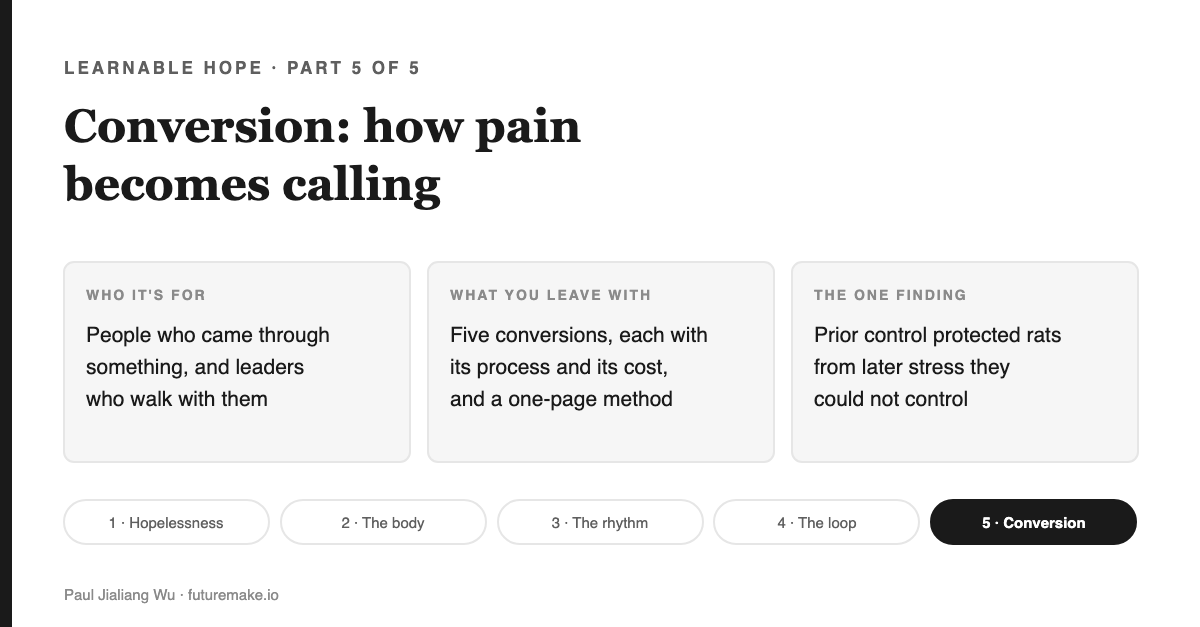
What this is. Part 5 of five. It checks "nothing is wasted" against physics and evidence, keeps what survives, and turns it into five conversions you can make on purpose, ending in the Shepherd's Academy of War members' track.
Why it matters. In rats, an early stressor the animal could control protected it against later stress it could not, and the protection needed the brain's control detector during the first experience. If anything like that holds for people, a recovered person who trains and teaches is building protection, for themselves and the person they teach.
What you can do after reading. Write one page: what you went through, what helped, what you would tell someone at the start. Remove anyone else's name and any medical promise, teach it to one person in ten minutes, and revise it.
Learnable Hope — the series spine
▶ See it running: open the live demo public · no sign-in
- Hopelessness — giving up is the default, hope is what gets learned episode 1
- The body — SBRO and MMA-style training, four weeks episode 2
- The rhythm — maximise calling, minimise cost episode 3
- The loop — observe, evaluate, control episode 4
- The conversion — pain into calling, and the members' track this episode
What can suffering be converted into, and how do you make the conversion on purpose?
This piece does not answer: Why hope can be learned — that is part 1. The first four weeks of training — that is part 2. How to keep the costs down while you push — that is part 3. How to steer week by week — that is part 4.
How to read the labels: EVIDENCE is sourced, TALK is what I said in a recorded talk (linked to the second), DESIGN is how the method is built, OPEN is not yet tested, and LENS is my own conviction.
A note before we start: I am an engineer, not a clinician or a physicist. This series is a training method, not a treatment, and nothing here is medical advice. Verses are quoted from the World English Bible (WEB), public domain.
What this part covers: conversion, and what it costs
Parts 1 to 4 were about getting out and staying out: a rep, a body that moves, a rhythm, a loop. This last part is about what the lost year becomes. My talks kept saying it in different words: pain can be converted. This part checks that claim against physics and against the evidence, keeps what survives, and turns it into the last module: teaching someone else. By conversion I mean turning an experience into use, not the religious sense of turning to God, though for me the two met.
It is for anyone who has come through something and wonders whether it was only loss, and for leaders who want to know what to do with people who have. You leave with an honest version of "nothing is wasted", a table of five conversions you can make on purpose, and the members' track where this series becomes practice.
The picture: the whole-body punch
A beginner punches with the arm. It is fast and it is light. A trained fighter punches with the whole body: the floor pushes the foot, the hips turn, the shoulder follows, and the fist is only the last link. Nothing new was added. The same body, organised, delivers far more.
TALK I explained it on tape with one line of physics: momentum is mass times velocity, and you cannot make your hand heavier, but you can bring the rest of you behind it. "I use my whole body" (LIVE Demo 4, 36:15).
| In the punch | In a life after pain |
|---|---|
| The arm alone | Your suffering kept private, carried by one part of you |
| The whole body behind the fist | The same experience organised into skill and service |
| The floor pushing back | The people and the God you lean on |
| Timing: hips before shoulder | Order: recover first, then teach |
| Energy lost as heat in a sloppy punch | Effort that is spent and does not come back |
| The bag moving | Someone else helped by what you learned |
Where the picture breaks: a punch converts energy in a fraction of a second, and physics guarantees the books balance. A life's conversion takes years, needs other people, and is not guaranteed at all. That is the honest part of this article.
What physics conserves, and what it does not
My talks used the language of conservation: time, space, energy, matter and intelligence, converted and preserved. The physics deserves precision before it carries a promise.
EVIDENCE In plain words: physics promises that nothing is lost only in a sealed box where the rules never change. Precisely, for a closed system whose rules do not change with time, energy is conserved; that is Noether's theorem, which ties each conservation law to a symmetry (Noether's theorem). A body still obeys energy conservation, but it is an open, dissipative system: energy flows through it, and in every real energy conversion some becomes heat that can no longer do work (second law of thermodynamics). Knowledge, which is not a physical quantity, has no conservation law at all: it is made and lost every day, and even erasing one stored bit has a minimum energy cost (Landauer's principle).
LENS So I no longer say "nothing is lost". Effort is spent; years are gone. What I say is narrower: pain is not conserved and does not change form by itself, but it can be converted, and conversion needs a process and an input. "Conversion" here is a figure, borrowed from the punch: the same body, organised, delivers more. Nobody turns suffering into anything by waiting. They do it the way a fighter puts the whole body behind the fist: by organisation, practice and timing.
What the evidence says conversion looks like
EVIDENCE The best mechanism I know is from animal work, so I hold it carefully. Rats that first faced a stressor they could control were protected from the usual effects of a later stressor they could not control: "Previous experience with stressors over which the subject has behavioral control blocks the typical behavioral consequences" of later uncontrollable stress, and the effect needed the medial prefrontal cortex during the first, controllable experience (Amat et al., 2006). OPEN Whether the same "immunisation" happens in people is a hypothesis, not a finding.
EVIDENCE In people, a small uncontrolled programme that combined expressive writing with non-contact boxing, for 17 survivors of child sexual abuse over eight weekly sessions, reported lower symptoms of post-traumatic stress, depression, anxiety and stress afterwards (Veltman et al., 2026). OPEN No control group, seventeen people: a prototype, not proof. But it is the shape of conversion: the body trained, the story told, in company.
The apostle Paul described a chain like this, two thousand years ago:
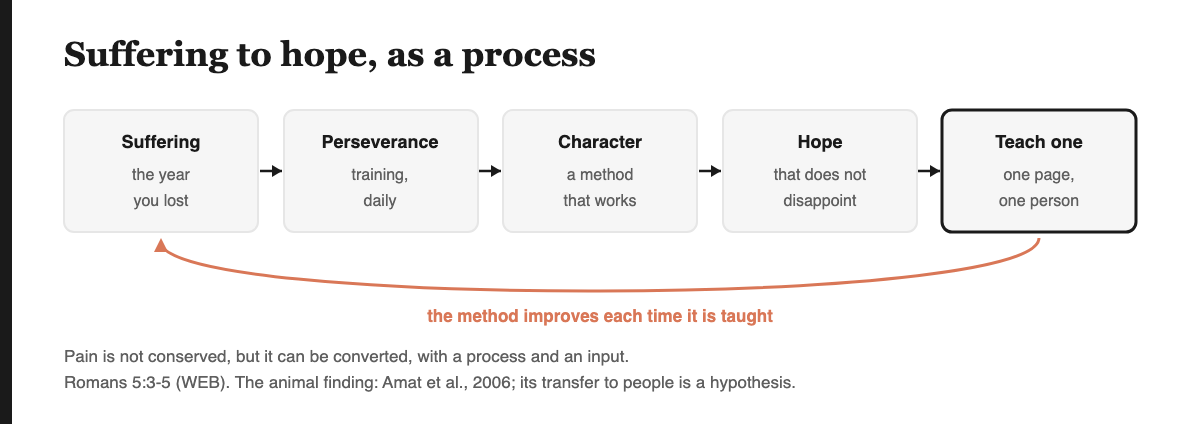
Not only this, but we also rejoice in our sufferings, knowing that suffering produces perseverance; and perseverance, proven character; and proven character, hope: and hope doesn’t disappoint us, because God’s love has been poured out into our hearts through the Holy Spirit who was given to us.
— Romans 5:3-5 (WEB, World English Bible)
LENS In that text suffering is not the good thing. What it produces is perseverance, and perseverance proves character. The apostle ends the chain with a hope that rests not on the process but on God's love already given. I take the shape of the chain from it, not a promise that training will produce that hope.
Five conversions
TALK I said it plainly in 2021: "we can turn trash into treasure" (part 2a, 59:04). Years later I could say how: "it's no longer a trauma it become my treasures", once I understood what had happened to me (part 3, 130:06). And the mechanism I kept pointing to was other people: "I use my own experience use my own resources to help those people who are having the same kind of struggle" (LIVE Demo 4, 76:22).
DESIGN Here are the five conversions I now teach, one per dimension I named in the talks, each with the process it needs and the cost it cannot avoid.
| Dimension | From | Into | The process | What it costs |
|---|---|---|---|---|
| Time | hours lost to the dark | hours of training | the daily rep and the weekly review | the hours themselves; they do not come back |
| Space | a room you hid in | a room where someone else rests | preparing a place for another person | comfort, and some privacy |
| Energy | adrenaline and restlessness | a drill, a round, a walk | SBRO, then the four-week plan | fatigue, which is why the dial oscillates |
| Matter | a body that shut down | a body that can carry others | strength and endurance, no head contact | soreness, small injuries, money for a gym |
| Intelligence | a story that only hurt | a method someone else can use | writing it down, testing it, teaching it | exposure: telling the truth in public |
TALK The last row is the one that matters most to me: "only after you experience the pain the suffering first hand by yourself you can do a bunch of makeover" (10X review, 23:18). And the multiplier is teaching: "help one or two or two or three people" (part 2b, 21:22).
Five whys
Why does so much suffering stay unconverted, even in people who have recovered?
- Because people put the year away and never look at it again, which is reasonable, and safe, for a while.
- Because it has no form anyone else can use. A story told only as pain is still worth telling, and lament is as old as the Psalms. But it does not yet have a form someone else can pick up and use.
- Because the process is missing. Conversion needs organisation, practice and timing, like the whole-body punch; good intentions do not supply it. The one programme I found that pairs body training with telling the story is a small pilot (Veltman et al., 2026).
- Because there is no one to teach. A method that is never taught is never tested, and is never finished.
- Root cause: no structure in which a recovered person practises and teaches what they learned, with others, over time. A church small group, a gym or a friendship can supply it; the members' track below is one attempt to supply it on purpose.
Operate
DESIGN The members' track: Shepherd's Academy of War (SAW), Learnable Hope. It is a members-only, eight-week discipleship track led by people, with an app that keeps the log. The eight weeks are this series in practice, with the modules overlapping: the one-rep log runs throughout from week 1 (part 1), the body plan in weeks 2 to 5 (part 2), the two-dial week from week 4 (part 3), the Sunday review from week 6 (part 4), and in weeks 7 and 8, the conversion: each member writes their own one-page method and teaches it to one person. The twelve-week horizon from part 4 continues after the track ends. LENS A taught method is the form a calling takes when it is still small: something only you could have written, given to one person.
DESIGN Three rules shape it. The software keeps logs and reminders; people do the care. It says plainly that it is software, and it is for adults. And every screen carries the crisis line, because companion chatbots left alone with people in the dark are now the subject of a federal inquiry (FTC, 2025), court cases (TechCrunch, 2025) and new state statutes (Transparency Coalition, 2026). The plan and the safety design are on the agentic-companion page. Cohort 1 is forming now; its leader gives each member the code that opens the page; the talks are on youtube.com/@godplaylab.
Feedback
What you measure in the track: members who complete eight weeks, the share whose State Hope Scale score rises from week 1 to week 8, and the count of one-page methods actually taught to someone else. The daily 0–10 number is a single self-rated item, not a validated scale, so at weeks 1 and 8 the leader also gives the six-item State Hope Scale on paper (Snyder et al., 1996).
OPEN The 10X, defined so it can fail. Cohort 1 aims to start on 2027-01-11 with 12 adults. By 2027-03-08: at least 8 finish, at least 6 teach their method, and at least 60% of finishers score higher on the State Hope Scale at week 8 than at week 1, and that share is at least 20 percentage points above the share among people on the waiting list who keep only the part-1 log (as many as join it). Stop line: fewer than 6 finish, or the gap with the waiting list is under 20 points; then it is redesigned and I say so here. Safety floor: if a member reports any thought of harming themselves, the leader makes contact within 24 hours, and every such event is reported in the cohort review. What the numbers cannot see: clinical change, which only a clinician can judge.
What it cannot see: whether a member is clinically better, which only a clinician can judge; whether the teaching helped the person taught; and the people who left quietly in week 2. The leader calls every member who misses two weeks.
Feedforward
Feedforward means acting before any error appears: on a plan, or on a disturbance you can see coming. Then come the tripwires below it: they are feedback rules, firing on something you observe (a number or an event), written in advance so a bad day cannot argue with them. They are reviewed after the first cohort, on 2027-03-15.
Seen coming. Telling your story can bring the old feelings back while you tell it. Before you teach your page, plan a walk afterwards and name one person you will call that evening.
DESIGN Tripwires, decided before the first cohort:
- Any member in crisis: the leader's first act is 988 or the local emergency number, never the app.
- Fewer than 6 of 12 finish: the next cohort is shorter, not harder.
- 6 or 7 of 12 finish: keep the length, and the leader talks with every non-finisher before the next cohort.
- A member's method contains a medical claim ("this cures", "stop your medication"): it is edited with them before it is taught.
- Week-8 State Hope Scale score at or below week 1 for most members: stop recruiting and redesign before the next cohort.
Who it is for. The members' track is for adults, 18 and over. If you are younger, everything in parts 1 to 4 works on your own sheet, and a family track, if there is one, will be designed with parents.
Laws and fashions
A law (★) is a claim that three or more independent research groups reach; a fact rests on one or two; a fashion is a dated item expected to change (a recent study, official guidance, a tool, or my own untested practice). Physics is cited as physics. Scripture is quoted as conviction, labelled LENS, and never counted as evidence.
- Physics: energy is conserved in a sealed box whose rules never change, and every real energy conversion loses some to heat (Noether's theorem, second law). These are not going to change.
- Fact (one research programme): earlier controllable stress protected rats from later uncontrollable stress (Amat et al., 2006), from the same lab as part 1's finding. Out of date if it fails to replicate, or never transfers to people.
- Fashions: the Left Write Hook pilot (2026); companion-chatbot rules (an FTC inquiry, 2025; new state statutes, 2025–2026), which are changing month by month.
On the mat and in the street
This section is about staying safe, not about expecting danger. If today is heavy, skip to the next one.
- Training: the senior student who once could not do a single round becomes the one who teaches the beginner. That is conversion in every good gym.
- Sparring: an experienced partner converts their old mistakes into the beginner's safety by going light.
- Competition: a loss reviewed honestly becomes next camp's game plan; a loss hidden becomes nothing.
- The street: the fear you felt in a confrontation can become a habit of noticing exits and leaving early, which is part 4's loop.
- An attack: run, hide, tell converts space and time into survival, and telling converts what you saw into help for others (Counter Terrorism Policing). The most useful conversion of fear I know is a bleeding-control class (Stop the Bleed).
Try it today
One page, one person
- Write one page: what you went through (one paragraph), what helped (three bullets), what you would tell someone at the start (one sentence).
- Remove anything that names another person or makes a medical promise.
- Pick one person who might be helped, with their consent.
- Teach it in ten minutes, and ask one question: what would you change?
- Revise the page. That revision is your method, version 2. :::
TRUE
The last two sections are my own check on this article: how it could be proved wrong, and how well I think it did.
- Transferable. Converting a hard experience into a taught method is how surgeons write case reports, engineers write post-mortems, and churches raise leaders. It transforms "what happened to me" into "what I can give".
- Recursive. This part is wrong if members who teach their method show no larger rise on the State Hope Scale from week 1 to week 8 than members who do not. I will compare them in the first cohort and re-read this part on 2027-06-01.
- Understandable. Pain isn't saved up automatically, but you can turn it into a skill that helps someone else, if you practise and teach it. The Theory U move (the inner move this part asks of you; see part 1) is prototype: make version 1 of your method and teach it.
- Experience it. Write the one page now, and watch the momentum clip; the talks are at youtube.com/@godplaylab. It would prove me wrong if teaching your page left both of you feeling worse.
- Built. The members' track and its safety design are on the agentic-companion page.
- Taught. That is the mission above: one page, one person, one revision.
5S self-score
| S | Self-score | Evidence |
|---|---|---|
| Simple | 4/5 | one picture, the whole-body punch, and one sentence: pain is not conserved, but it can be converted |
| Solid | 4/5 | the physics is stated precisely with its limits; the conversion evidence is labelled animal and uncontrolled |
| Sharp | 4/5 | the root cause is a missing structure for practice and teaching, which the track supplies |
| SMART | 4/5 | an eight-week track with a cohort bar (12, 8, 6) and five decided stop rules |
| Super-fun | 3/5 | teaching a friend is fun; writing about the dark year is not, and it is still worth doing |
Sources
- Noether's theorem (overview). https://en.wikipedia.org/wiki/Noether%27s_theorem
- Second law of thermodynamics (overview). https://en.wikipedia.org/wiki/Second_law_of_thermodynamics
- Landauer's principle (overview). https://en.wikipedia.org/wiki/Landauer%27s_principle
- Amat et al. (2006), behavioural control and later stress, J Neurosci 26:13264–13272. https://europepmc.org/article/MED/17182776
- Veltman et al. (2026), Left Write Hook: writing and non-contact boxing. https://europepmc.org/article/PMC/PMC13587543
- Counter Terrorism Policing, Run Hide Tell. https://www.counterterrorism.police.uk/runhidetell/
- Stop the Bleed (American College of Surgeons). https://www.stopthebleed.org/
- 988 Suicide & Crisis Lifeline. https://988lifeline.org/
- My talks: Win Depression 2a, 2b and 3, the 10X review, LIVE Demo 4, GodPlay. https://www.youtube.com/@godplaylab
Where this part sits in the series
| Conception | Core concept | Governing principle | Main contributors | |
|---|---|---|---|---|
| Hopelessness (part 1) | Psalm 42 → Seligman & Maier (1967) → Abramson et al. (1978) → Maier & Seligman (2016) | giving up is the default; hope is the learned skill | supply a small, visible experience of control, daily | Martin Seligman · Steven Maier · Lyn Abramson · C. R. Snyder · Pim Cuijpers |
| The body (part 2) | 1 Kings 19 → Isaiah 35 → behavioural activation (2007) → the BMJ network meta-analysis (2024) | the body is the cheapest place to experience control | body first, no head contact, add one thing a week | Michael Noetel · Felipe Schuch · Gabriele Wulf · Ian Moore |
| The rhythm (part 3) | Hebrews 12 → progressive overload (ACSM, 2009) → MMA injury meta-analysis (2014) → instrumented mouthguards (2021) | calling and cost held in one designed rhythm | oscillate on purpose; the cost side gets the first vote | Reidar Lystad · the ACSM · Gabriele Wulf · DHS and Counter Terrorism Policing |
| The loop (part 4) | Watt's governor → Wiener (1948) → Boyd's OODA sketch (1995) → Åström & Murray (2008) | feedforward plus feedback at every time scale | a fixed time, a fixed bar, one change, one outside reader | John Boyd · Karl Åström · Richard Murray · Arne Nieuwenhuys |
| Conversion (this part) | Romans 5 → Noether (1918) → Landauer (1961) → Amat et al. (2006) | pain is not conserved, but it can be converted | conversion needs a process, an input and someone to teach | Emmy Noether · Rolf Landauer · José Amat · the Left Write Hook team |