AI-NATIVE SERIES · LEARNABLE HOPE, PART 3 OF 5
Maximise Calling, Minimise Cost: The Oscillation a Fighter Learns Every Round
1-minute takeaway
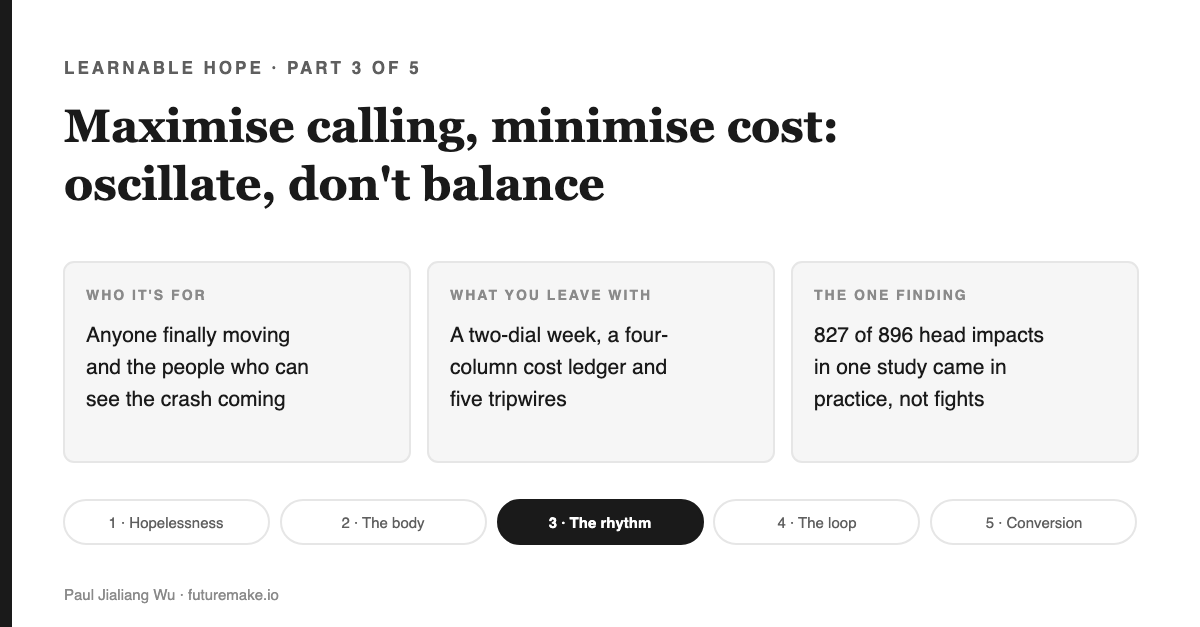
What this is. Part 3 of five. It answers how to push toward a calling without breaking yourself or the people around you, using the intensity dial every fighter learns: hard days, light days, off days, planned in advance, with costs counted in four columns.
Why it matters. In one study of boxers and MMA athletes, 827 of 896 verified head impacts happened in practice, not competition. Costs accumulate where nobody is counting. The same is true of money, sleep and family, and a recovered person who sets the dial once, at maximum, often loses what they just found.
What you can do after reading. Plan next week as two hard, three light and two off days. Keep the four-column cost ledger (body, heart, money, people) each evening, and follow the five tripwires when a column turns red.
Learnable Hope — the series spine
▶ See it running: open the live demo public · no sign-in
- Hopelessness — giving up is the default, hope is what gets learned episode 1
- The body — SBRO and MMA-style training, four weeks episode 2
- The rhythm — maximise calling, minimise cost this episode
- The loop — observe, evaluate, control episode 4
- The conversion — pain into calling, and the members' track episode 5
How do you push toward your calling hard enough to matter without paying for it in injuries to body, heart, money or people?
This piece does not answer: Why hope can be learned at all — that is part 1. What to do with your body in the first four weeks — that is part 2. How to read the numbers each week and decide what to change — that is part 4. What the whole effort converts into — that is part 5.
How to read the labels: EVIDENCE is sourced, TALK is what I said in a recorded talk (linked to the second), DESIGN is how the method is built, OPEN is not yet tested, and LENS is my own conviction.
A note before we start: I am an engineer and a recreational martial artist, not a clinician, a coach or a lawyer. This series is a training method, not a treatment, and nothing here is medical, legal or financial advice. Verses are quoted from the World English Bible (WEB), public domain.
What this part covers: calling and cost, held in one rhythm
Part 2 got the body moving. The danger after a few good weeks is the opposite of the danger before them. Someone who has just found hope wants to make up for the lost year, and burns it in a month: an injury, a blow-up with a spouse, money spent on a dream, a schedule that cannot last.
This part is for the person who is finally moving and wants to move toward something big, and for the people around them who can see the crash coming. By calling I mean the work you believe you are called to, which no one else will do for you; what gets maximised is the work toward it, not the calling itself. It answers one question: how do you push toward your calling hard enough to matter, without paying for it in injuries of any kind? You leave with a two-dial week, a four-column cost ledger, and one rule from the gym that I now use for everything: oscillate, don't balance.
The picture: the intensity dial in a sparring room
Every good gym has a dial nobody can see. On Monday the coach turns it up: hard pads, hard conditioning, the round that makes you want to quit. On Tuesday it goes down: technique at half speed, light flow, mobility. Before a fight it goes up for weeks and then drops sharply so the body arrives fresh. A fighter who keeps the dial at maximum gets hurt; a fighter who keeps it at minimum never gets good. The skill is moving it on purpose.
| In the gym | In a life |
|---|---|
| The hard round | Work toward your calling |
| The light round | Recovery: sleep, family, a slow walk |
| Head impacts, sprains, cuts | Costs: physical, emotional, financial, relational |
| The coach turning the dial | You, deciding the week before it starts |
| Training camp then taper | A season of push, then a season of rest |
| Tapping out | A stop rule you agreed to in advance |
Where the picture breaks: a fighter's cost is mostly physical and mostly theirs. A life's costs land on other people too, children and spouses especially, and they cannot tap out for you. So in a life the cost side gets the first vote.
The maximum side: calling
TALK My talks kept returning to one engine: a future that pulls instead of a will that pushes. "this big and exciting things pulling the current you forward not push you forward pulling you forward" (LOVE 12X YOU, 32:42). I set horizons I could see the end of: "right now is september the 4th see you in december the 4th exactly 12 weeks" (MMA makeover part 2, 07:30).
EVIDENCE Intensity is a real dial in the evidence too. In the network meta-analysis of 218 trials from part 2, vigorous exercise had a larger effect than light exercise (g = −0.74 against −0.58; a bigger minus means more improvement), and the authors saw a clear dose-response for intensity, while the link to total weekly volume was unclear (Noetel et al., 2024). Strength gains need progression: the American College of Sports Medicine's position is that further adaptation requires progressive overload (ACSM, 2009).
TALK On tape I said ten percent a week for fifty weeks would multiply you more than a thousand times (part 1b, 91:37). The arithmetic says 1.1 to the 50th power is about 117, and real bodies don't compound like that anyway: gains slow as you adapt. LENS What survives is the rule behind it: raise the load a little, only when you have beaten the current one, and stay healthy enough to keep doing it.
The minimum side: four costs
Physical. EVIDENCE In competition, MMA (mixed martial arts) produces about 229 injuries per 1,000 athlete-exposures (95% CI 110–474, from six very different studies; there is no pooled rate for training), and the head takes most of them (Lystad et al., 2014). Training is where the volume is: in one study with instrumented mouthguards, 827 of 896 verified head impacts happened in practice, not competition (Jansen et al., 2021). In another small study, all five concussions happened in competition and none in sparring (Tiernan et al., 2020); in the mouthguard study, competition impacts were also the harder ones. DESIGN So the rule for this programme is pads, bags and flow drills, never head contact, and protective gear always.
Emotional. Anger and contempt carried into training cost you and your partner. TALK When I called myself a "recreator" of MMA I listed what I wanted to drop: "i don't like the trash talk i don't like the the injury obviously" (MMA makeover part 1, 05:05). And the rule I gave every sparring partner: "always protect yourself always consider the other person who also wants safety as much as you do" (part 2, 02:02). Training from anger trains anger.
Financial. TALK My rule for spending was ten to one: spend a dollar only where it buys about ten dollars of value, used shoes over new ones, one gym membership over three (10X review, 30:32). LENS Hope after depression often wants to buy its way forward. A calling that needs debt to start is usually a calling that needs a smaller first step.
Relational. TALK For difficult people I taught five steps I called RAISE: hear them out without pushing back, thank them, assume they meant well, feel what they feel, then point out what they do well (LOVE 12X YOU, 93:15). LENS It costs nothing in money and a great deal in attention, which is why it belongs on the cost ledger.
Oscillate, don't balance
TALK In the same 2022 session where I taught the punches, I gave one rule for learning any movement: "always take baby step always start very small magnitude very very slow it's like you're practicing Tai Chi" (LIVE Demo 4, 28:52). Then: increase the size a little, increase the speed a little, and if you lose coordination, slow down and shrink it again until the fluency comes back.
LENS That is oscillation, not balance. Balance is a midpoint you sit at. Oscillation here is a planned rhythm: up toward the edge of what you can do, back down before something breaks, up again. (Part 4 meets the other kind, a loop that swings past its target because nobody planned it.) A heart is healthy because it beats, not because it holds still. The older word for the push is endurance:
Therefore let us also, seeing we are surrounded by so great a cloud of witnesses, lay aside every weight and the sin which so easily entangles us, and let us run with perseverance the race that is set before us, looking to Jesus, the author and perfecter of faith, who for the joy that was set before him endured the cross, despising its shame, and has sat down at the right hand of the throne of God.
— Hebrews 12:1-2 (WEB, World English Bible)
LENS "Lay aside every weight" is about dropping what slows you down, which is close to, but not the same as, counting what your effort costs others. And the passage's own example is a cost that was not minimised but endured, for a joy set ahead. That is the limit of this part's rule: some costs are worth paying, and the ledger is for telling them apart.
Five whys
Why do people who have just found hope so often crash within a few months?
- Because they overspend one kind of cost: a shoulder, a marriage, savings, sleep.
- Because they set the dial once, at maximum, to make up for lost time; strength guidance raises the load in small steps once the current load is done with reps to spare (ACSM, 2009).
- Because nobody counted the costs in advance. Effort is visible and celebrated; cost is invisible until it arrives, and it arrives on other people too. In one small study of amateur fighters wearing sensor mouthguards, 827 of 896 head impacts happened in practice, not in competition (Jansen et al., 2021); in an ordinary gym, nobody is counting.
- Because "balance" sounded like going back to the stuck place, so they refused the down-beat.
- Root cause: no rhythm was designed. A plan that only has a push has no recovery, and a body or a family will take the recovery by force. Design the oscillation and count the cost before the week starts.
Operate
DESIGN Two tools, both on one sheet.
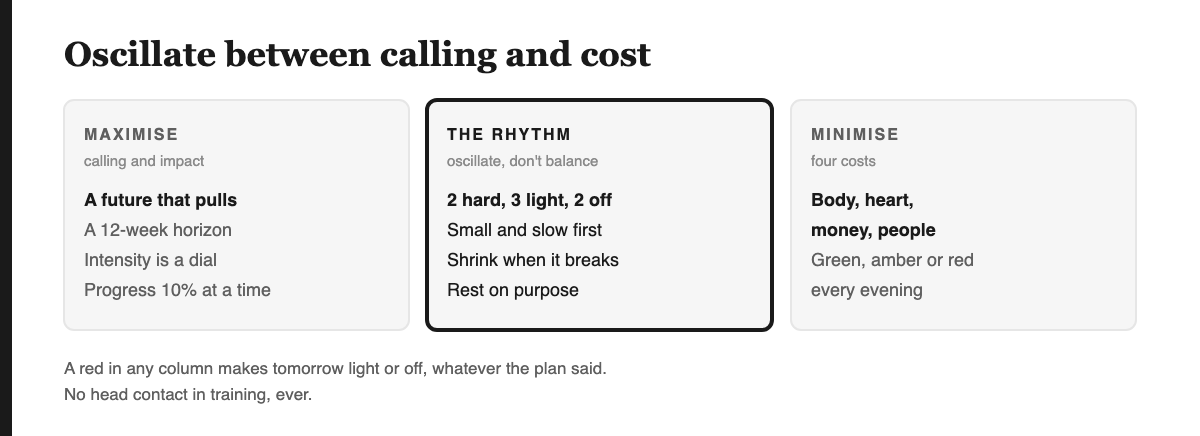
The two-dial week. On Sunday, mark each day of the coming week H (hard, toward the calling), L (light, recovery or technique) or O (off). The default is two H, three L, two O. Hard days are where the calling work and the hard training go; never more than two in a row.
The cost ledger. Four columns: body, heart, money, people. Each evening, one mark per column: green (no cost), amber (some cost, recoverable), red (a cost I would not want to repeat). A red in any column means tomorrow is an L or an O, whatever the plan said.
Feedback
What you measure: H days done against planned, and the count of reds per column per week. OPEN My bar is that H days hit at least 80% of plan over the month while reds stay at one or fewer per week in every column.
What it cannot see: costs that are slow to show, such as a child pulling away or a debt that compounds quietly; costs other people are not telling you about; and the difference between a cost that builds you and one that breaks you. Ask the people closest to you once a week what the plan is costing them.
Feedforward
Feedforward means acting before any error appears: on a plan, or on a disturbance you can see coming. Then come the tripwires below it: they are feedback rules, firing on something you observe (a number or an event), written in advance so a bad day cannot argue with them. They are reviewed after the first cohort, on 2027-03-15.
Seen coming. A deadline, a family event, a trip, a month with a big bill. When you can see one in next week, plan that week with one hard day instead of two, and tell the people it affects before it starts.
DESIGN Tripwires, decided in advance:
- Two reds in the same column in one week: next week drops to one H day.
- Any head contact in training: stop that drill for good.
- Spending on the calling beyond what you set aside in advance: pause for seven days before buying anything else.
- Someone at home says "I miss you" twice in a week: one H day becomes a day with them.
- Hope number falling for two weeks while the H days are hitting: the dial is too high; drop to one H day and tell your doctor or counsellor if you have one.
Laws and fashions
A law (★) is a claim that three or more independent research groups reach; a fact rests on one or two; a fashion is a dated item expected to change (a recent study, official guidance, a tool, or my own untested practice). Physics is cited as physics. Scripture is quoted as conviction, labelled LENS, and never counted as evidence.
- Fact (two sources): harder sessions do more, and supervised trials showed larger effects: Noetel et al., 2024 (intensity), Schuch et al., 2016 (intensity and supervision). Out of date if the most careful trials find that harder sessions do no more than easy ones.
- Facts (one small study each): most head impacts happened in practice (Jansen et al., 2021); in another study all the concussions were in competition (Tiernan et al., 2020). Expected to be refined as sensor mouthguards spread.
- Fashion: the official street and attack guidance quoted here (Vancouver Police, DHS 2008, Counter Terrorism Policing) is revised from time to time; check the current page.
On the mat and in the street
This section is about staying safe, not about expecting danger. If today is heavy, skip to the next one.
- Training: the coach's dial: hard rounds, then technique, then mobility. Nobody is admired for training hurt.
- Sparring: light, controlled and agreed in advance; the point is information, not damage.
- Competition: the one place the dial is set to maximum on purpose, for a short time, followed by a long rest. This programme does not require it.
- The street: the highest-value outcome is going home. Official advice is plain: if someone demands your phone or money, "hand over the item or money and call 911 right away" (Vancouver Police). A phone is replaceable; an injury, a court case or a funeral is not. In US law generally, self-defence requires an imminent threat and proportionate force, and the details vary by state (Criminal Law, ch. 5.2); this is not legal advice.
- An attack: the official order puts the lowest-cost options first: run, hide, then tell the police when it is safe (Counter Terrorism Policing). Physical action against an attacker is, in the US government's words, "as a last resort, and only when your life is in imminent danger" (DHS).
Try it today
Plan one oscillating week
- Write the seven days of next week. Mark two H, three L, two O.
- Under each H, write one thing toward your calling and one hard training session.
- Draw the four-column cost ledger: body, heart, money, people.
- Show the plan to one person it affects and ask what it will cost them.
- Each evening, one mark per column. Adjust tomorrow by the rule. :::
TRUE
The last two sections are my own check on this article: how it could be proved wrong, and how well I think it did.
- Transferable. Oscillate-don't-balance works for a startup's sprint and cooldown, a student's exam season, and a church's busy calendar. It transforms "work-life balance" from a midpoint into a designed rhythm with stop rules.
- Recursive. This part is wrong if members who keep the two-dial week report more reds, not fewer, than those who plan without it. I will check the first cohort's ledgers and re-read this part on 2027-04-15.
- Understandable. Push hard toward what you're called to, then rest on purpose, and count what it costs your body, heart, money and people. The Theory U move (the inner move this part asks of you; see part 1) is redirect: look at the week from the side of the people who pay for it.
- Experience it. Watch the one-minute dial clip and plan next week now; the full talks are on youtube.com/@godplaylab. It would prove me wrong if a planned two-H week produced as many reds as an unplanned one.
- Built. The two-dial week and the cost ledger are module 3 of the members' track (part 5).
- Taught. Teach the four cost columns to someone who has just started something big, and ask which column they had forgotten.
5S self-score
| S | Self-score | Evidence |
|---|---|---|
| Simple | 4/5 | one rule (oscillate, don't balance) and one sheet with two tools |
| Solid | 4/5 | injury, intensity and progression numbers link to fetched papers; my own 1,000x claim is corrected in the text to 117 |
| Sharp | 4/5 | the five whys reach a design gap, no rhythm planned, not a character flaw |
| SMART | 4/5 | a 2-3-2 week, a numeric bar (80% of H days, ≤1 red per column) and five tripwires |
| Super-fun | 3/5 | the hard days are fun; the ledger is honest, not fun |
Sources
- Noetel et al. (2024), intensity dose-response, BMJ 384:e075847. https://europepmc.org/article/PMC/PMC10870815
- ACSM (2009), "Progression models in resistance training for healthy adults". https://europepmc.org/article/MED/19204579
- Lystad, Gregory & Wilson (2014), MMA injury meta-analysis. https://pmc.ncbi.nlm.nih.gov/articles/PMC4555522
- Jansen et al. (2021), instrumented mouthguards in boxing and MMA. https://pmc.ncbi.nlm.nih.gov/articles/PMC8664317
- Tiernan et al. (2020), head impacts in MMA sparring and competition. https://pmc.ncbi.nlm.nih.gov/articles/PMC10330963
- Vancouver Police Department, personal safety. https://vpd.ca/crime-prevention-safety/personal-safety/
- Criminal Law, ch. 5.2 "Self-defense" (University of Minnesota Libraries). https://courses.lumenlearning.com/suny-criminallaw/chapter/5-2-self-defense/
- Counter Terrorism Policing, Run Hide Tell. https://www.counterterrorism.police.uk/runhidetell/
- U.S. Department of Homeland Security, Active Shooter: How to Respond (2008). https://www.dhs.gov/xlibrary/assets/active_shooter_booklet.pdf
- My talks: LOVE 12X YOU part 1, MMA makeover parts 1–2, 10X review, Win Depression 1b, LIVE Demo 4. https://www.youtube.com/@godplaylab
Where this part sits in the series
| Conception | Core concept | Governing principle | Main contributors | |
|---|---|---|---|---|
| Hopelessness (part 1) | Psalm 42 → Seligman & Maier (1967) → Abramson et al. (1978) → Maier & Seligman (2016) | giving up is the default; hope is the learned skill | supply a small, visible experience of control, daily | Martin Seligman · Steven Maier · Lyn Abramson · C. R. Snyder · Pim Cuijpers |
| The body (part 2) | 1 Kings 19 → Isaiah 35 → behavioural activation (2007) → the BMJ network meta-analysis (2024) | the body is the cheapest place to experience control | body first, no head contact, add one thing a week | Michael Noetel · Felipe Schuch · Gabriele Wulf · Ian Moore |
| The rhythm (this part) | Hebrews 12 → progressive overload (ACSM, 2009) → MMA injury meta-analysis (2014) → instrumented mouthguards (2021) | calling and cost held in one designed rhythm | oscillate on purpose; the cost side gets the first vote | Reidar Lystad · the ACSM · Gabriele Wulf · DHS and Counter Terrorism Policing |
| The loop (part 4) | Watt's governor → Wiener (1948) → Boyd's OODA sketch (1995) → Åström & Murray (2008) | feedforward plus feedback at every time scale | a fixed time, a fixed bar, one change, one outside reader | John Boyd · Karl Åström · Richard Murray · Arne Nieuwenhuys |
| Conversion (part 5) | Romans 5 → Noether (1918) → Landauer (1961) → Amat et al. (2006) | pain is not conserved, but it can be converted | conversion needs a process, an input and someone to teach | Emmy Noether · Rolf Landauer · José Amat · the Left Write Hook team |