AI-NATIVE SERIES · LEARNABLE HOPE, PART 4 OF 5
Observe, Evaluate, Control (OEC): Steering a Life the Way a Fighter Steers a Round
1-minute takeaway
What this is. Part 4 of five. It gives one loop, observe, evaluate, control, that works from a single punch to a decade, and credits where it comes from: control theory and John Boyd's OODA sketch, which labels both feedforward and feedback.
Why it matters. Police officers who practised a skill under mild anxiety stopped losing performance under stress, and kept the gain at four months. Plans that are never measured, and measurements never compared with a plan, are how training quietly stops working.
What you can do after reading. Book a fifteen-minute Sunday review: five minutes observe, five evaluate, five control, one change only. Write one twelve-week target with a date, name one outside reader, and practise noticing two exits in every building.
Learnable Hope — the series spine
▶ See it running: open the live demo public · no sign-in
- Hopelessness — giving up is the default, hope is what gets learned episode 1
- The body — SBRO and MMA-style training, four weeks episode 2
- The rhythm — maximise calling, minimise cost episode 3
- The loop — observe, evaluate, control this episode
- The conversion — pain into calling, and the members' track episode 5
How do you steer, with feedforward and feedback, from the next second to the next decade?
This piece does not answer: Why hope can be learned — that is part 1. What to train in the first four weeks — that is part 2. How hard to push and how to count the cost — that is part 3. What the whole effort becomes, and the members' track — that is part 5.
How to read the labels: EVIDENCE is sourced, TALK is what I said in a recorded talk (linked to the second), DESIGN is how the method is built, OPEN is not yet tested, and LENS is my own conviction.
A note before we start: I am an engineer, not a clinician, a coach or a security professional. This series is a training method, not a treatment, and nothing here is medical, legal or security advice. Verses are quoted from the World English Bible (WEB), public domain.
What this part covers: OEC at every time scale
Parts 1 to 3 gave you things to do: a rep, a warm-up, a week with a rhythm. This part is about steering: how to know, while it is happening, whether it is working, and what to change. I call the loop OEC: observe, evaluate, control. It is not new, and I will show where it comes from.
It is for anyone who has started training and keeps asking "is this doing anything?", and for coaches who want a single loop they can teach at every scale, from one punch to one decade. You leave with the difference between feedforward and feedback in one table, a fifteen-minute weekly review, and a twelve-week plan that can go red.
The picture: the corner between rounds
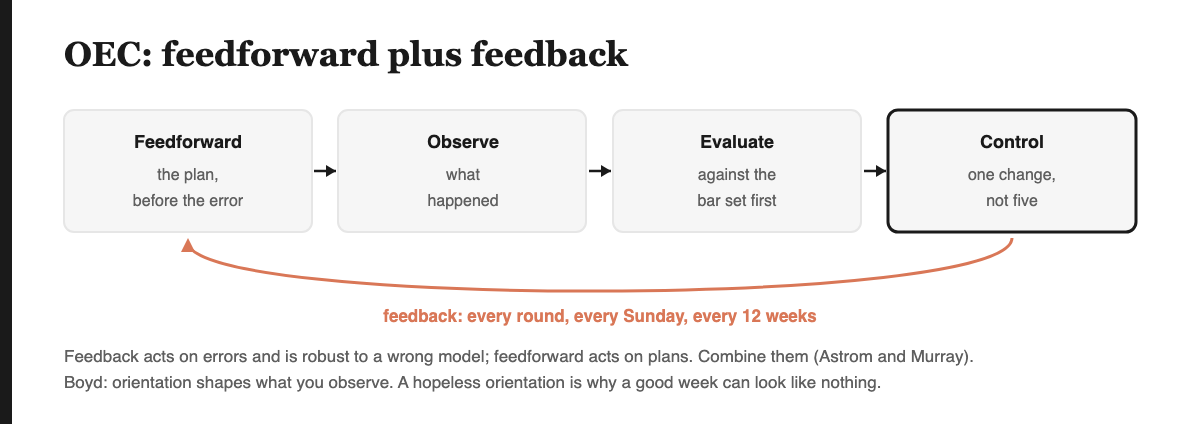
A boxing round lasts three minutes. Then the fighter sits on a stool for sixty seconds, and the coach does three things fast. Observe: what happened, what landed, what did not. Evaluate: against the plan for this fight, are we winning the round we meant to win? Control: one instruction, never five. "Double the jab. Circle left." Then the bell.
Before the fight there was also a plan, the game plan, built from watching the opponent for weeks. That plan is feedforward. The corner's sixty seconds are feedback. Good fighters need both.
| In the corner | In the loop |
|---|---|
| The game plan built before the fight | Feedforward: act on a model before the error appears |
| Sixty seconds on the stool | Feedback: correct after the error is measured |
| "What happened?" | Observe |
| "Against the plan, how are we doing?" | Evaluate |
| One instruction | Control: the smallest change that matters |
| The fighter's trained habits | The body's feedforward model, tuned by drills |
| A coach who sees what the fighter cannot | Someone outside your head who reads your numbers |
Where the picture breaks: a fight has a referee, fixed rounds and an end. A life has none of those. So you have to build the rounds yourself: a day, a week, twelve weeks, a year.
Where the loop comes from
EVIDENCE Control engineers have a clean definition. Feedback is reactive: "there must be an error before corrective actions are taken." Feedforward measures or predicts a disturbance and acts before it arrives. Their summary table: feedback acts on deviations and is robust when your model is wrong, but carries a risk of instability (swinging past the target, the unplanned cousin of part 3's rhythm); feedforward acts on plans and is sensitive to model errors; and "it is often advantageous to combine feedback and feedforward" (Åström & Murray, *Feedback Systems*). The same textbook notes that feedforward has been suggested as essential for human motion control, "tuned during training".
EVIDENCE John Boyd, a fighter pilot, drew the most famous version of the loop: observe, orient, decide, act. In the only sketch of it he drew, arrows are labelled both "Feed Forward" and "Feedback", and orientation sits in the middle. In his words: "Note how orientation shapes observation, shapes decision, shapes action, and in turn is shaped by the feedback" (Boyd, *The Essence of Winning and Losing*, 1995).
LENS OEC is a simplified descendant of Boyd's loop, nothing more. I fold "orient" and "decide" into evaluate, because for a person training out of hopelessness the important point is the one Boyd made: orientation filters what you can even observe. Acquired hopelessness is an orientation. It is why a depressed person can look at a good week and see nothing.
The same loop at six scales
TALK I said it in a 2021 talk in data-science language: "every model is wrong some are useful sometimes a good data scientist always put his model through stress tests" (part 1b, 79:46). A plan is a model. OEC is how it gets stress-tested.
| Scale | Feedforward (the plan) | Observe | Evaluate | Control |
|---|---|---|---|---|
| 1 second, one punch | an imagined target | where the hand went | on target or not | the next punch |
| 3 minutes, one round | the drill for this round | effort, breath | still fluent? | slow down and shrink (part 3) |
| 1 day | today's one rep | done or not, hope number | against yesterday | tomorrow's rep size |
| 1 week | the two-dial week | H days, reds | against the bar | next week's dial |
| 12 weeks | one horizon you can see the end of | weekly averages | against the 12-week target | change one thing in the plan |
| 12 years | the future self that pulls | the year's log | does it still pull? | re-aim, or keep going |
TALK At the twelve-week scale I kept a horizon short enough to finish and long enough to change: "three months will be great uh it's short enough uh to allow me to have room to grow but it is uh it's long enough for me to grow" (10X review, 03:32). At the scale of a day I logged what I did and fed it back: "I fit those data into a recommendation system I build and to give me better strategies" (33:28). You do not need a recommendation system. A sheet and a Sunday will do.
LENS One verse has the same shape, seeing first and then doing:
Jesus therefore answered them, “Most certainly, I tell you, the Son can do nothing of himself, but what he sees the Father doing. For whatever things he does, these the Son also does likewise.
— John 5:19 (WEB, World English Bible)
LENS I read its seeing and then doing as the shape of feedforward: look at the model first, then act. In my practice that looking is a quiet minute with God before the day's plan. The verse is about the Son's unity with the Father, not a lesson in technique; the shape is what I borrow. That is my conviction, not evidence, and the loop works the same way for a reader who does not share it.
Training the loop under stress
EVIDENCE Skills can fail under fear, and practising them under mild fear may protect them. In a small study of 27 police officers, those who trained a skill under mild induced anxiety no longer dropped in performance when anxious, and the gain lasted four months; the comparison group, trained without anxiety, still dropped (Nieuwenhuys & Oudejans, 2011). Under high threat, officers also responded earlier: their distance perception did not change, but the link between distance and perceived threat did (Nieuwenhuys et al., 2012). DESIGN So the members' track adds pressure in small steps: the same drill, then the same drill timed, then with noise.
EVIDENCE Breathing is a tool you always carry. In a randomised study of 108 people practising five minutes a day for 28 days, breathwork as a group raised positive mood more than mindfulness did, and of the single techniques only cyclic sighing, a double inhale and a long exhale, beat mindfulness on its own (Balban et al., 2023). OPEN It was a small, remote study; I teach the long exhale as a habit, not a cure.
Five whys
Why do people keep training for weeks without knowing whether it is working?
- Because they never look. The log exists, or does not, but nobody reads it.
- Because nobody set a bar in advance, so any result can be read as success or failure depending on the mood that day.
- Because the orientation filters the observation. Orientation shapes what you observe (Boyd), and a hopeless explanatory style reads a good week as luck and a bad day as proof (Abramson et al., 1978).
- Because there is feedforward without feedback, a plan nobody corrects, or feedback without feedforward, endless reacting with no plan to correct toward.
- Root cause: no designed loop with a fixed time, a fixed bar and one outside reader. Build that, and the orientation gets new data it cannot ignore.
Operate
DESIGN Two things.
The fifteen-minute Sunday review. Same time each week, same sheet.
- Observe (5 minutes): copy the week's numbers: reps or sessions done, H days, reds per column, average hope number.
- Evaluate (5 minutes): against last week, and against the bar you wrote in advance. One sentence: on track, behind, or ahead.
- Control (5 minutes): change exactly one thing for next week, and write it down.
One twelve-week horizon. Write one target you can check on a date twelve weeks out, such as "40 logged sessions by 2027-02-08" (twelve weeks from 16 November 2026), plus the weekly bar that gets you there. Read the review to one person every fourth Sunday.
Feedback
What you measure: reviews done per month (the loop's own health), and whether the twelve-week target is on pace at weeks 4 and 8. OPEN My bar is four reviews a month and on-pace at both checkpoints.
What it cannot see: it reads your numbers, not your life. It cannot see that a target was the wrong target, and it cannot replace a clinician reading a clinical scale. A loop that only you read is still inside your orientation; that is why one outside reader is part of the design.
Feedforward
This part defines the words, so here is the exact sense. Feedforward acts before any error appears, on a plan or on a disturbance you can see coming; here the plan is the twelve-week target, and the disturbances are the weeks you know will be hard. Every tripwire below is a feedback rule written in advance: it fires on something you observe (a number or an event), but the response was chosen before the bad week could argue with it. They are reviewed after the first cohort, on 2027-03-15.
Seen coming. Before a week you know will be heavy, move the Sunday review earlier and tell your outside reader in advance what you expect.
DESIGN Tripwires, pre-committed:
- Two missed reviews in a row: the next review happens with your outside reader, in person or on a call.
- Behind pace at week 4: halve the twelve-week target rather than doubling the effort.
- Behind at week 8 again: the plan, not you, is the problem; rewrite it with your reader.
- Hope number down for three weeks running: see a doctor or counsellor; the loop has found something it cannot fix.
- Any thought of harming yourself: call 988 (US) or your local emergency number. The loop stops until you are safe.
Laws and fashions
A law (★) is a claim that three or more independent research groups reach; a fact rests on one or two; a fashion is a dated item expected to change (a recent study, official guidance, a tool, or my own untested practice). Physics is cited as physics. Scripture is quoted as conviction, labelled LENS, and never counted as evidence.
- Fact (two sources): combine feedforward and feedback. It is a textbook result in control engineering (Åström & Murray), and Boyd draws both arrows in his OODA sketch (Boyd, 1995). It would be out of date only if control theory were.
- Fashions, each a single small study: training under mild anxiety (27 officers, 2011); cyclic sighing (108 people, 2023). Expected to be confirmed or overturned by larger trials.
On the mat and in the street
This section is about staying safe, not about expecting danger. If today is heavy, skip to the next one.
- Training: one rep is a loop: cue, movement, look at where it went, adjust. Video replay is feedback; the coach's cue is feedforward.
- Sparring: the corner between rounds is the clearest OEC there is: observe, evaluate against the plan, one instruction.
- Competition: the game plan built from watching the opponent is feedforward at the scale of weeks.
- The street: awareness is feedforward. Noticing the nearest exits when you walk in, and leaving early when something feels wrong, is the whole civilian version. Official advice is to report behaviour, not appearance: "Factors such as race, ethnicity, sex, national origin, religion, or disability are not suspicious." (DHS, Recognize the Signs).
- An attack: run, hide, tell is a plan learned before it is needed; telling the police once you are safe is the feedback that lets others act (Counter Terrorism Policing).
Try it today
Your first review, this Sunday
- Put a fifteen-minute slot in your calendar for Sunday, recurring.
- Write one twelve-week target with a date, and the weekly number that gets you there.
- On Sunday: five minutes observe, five evaluate, five control. One change only.
- Name one outside reader, and ask them now.
- Next time you enter a building, notice two exits. That is feedforward, practised. :::
TRUE
The last two sections are my own check on this article: how it could be proved wrong, and how well I think it did.
- Transferable. OEC is how a product team runs a sprint review, how a pilot flies an approach and how a parent adjusts bedtime. It transforms "try harder" into "change one thing, on a schedule, against a bar".
- Recursive. This part is wrong if members who do weekly reviews reach their twelve-week targets no more often than those who do not. I will compare them in the first cohort and re-read this part on 2027-05-01.
- Understandable. Make a plan, look at what happened each week, compare it with the plan, and change one thing; do it at every scale. The Theory U move (the inner move this part asks of you; see part 1) is crystallize: turn a vague hope into one dated target.
- Experience it. Book the Sunday slot now and watch the one-second loop in the clip; the full session is LIVE Demo 4 on youtube.com/@godplaylab. It would prove me wrong if twelve weeks of reviews changed nothing in what you did.
- Built. The Sunday review is module 4 of the members' track, where a human leader reads it with you (part 5).
- Taught. Draw the six-scale table for someone else from memory, and ask them which scale they never look at.
5S self-score
| S | Self-score | Evidence |
|---|---|---|
| Simple | 4/5 | three words and the corner's sixty seconds as the picture |
| Solid | 5/5 | definitions quoted from the control textbook and from Boyd's own sketch; OEC is credited as a descendant, not an invention |
| Sharp | 4/5 | the root cause is a missing designed loop, and the fix names its time, bar and reader |
| SMART | 5/5 | a fifteen-minute weekly slot, a dated twelve-week target and checkpoints at weeks 4 and 8 |
| Super-fun | 3/5 | the exits game is fun; the review is useful |
Sources
- Åström & Murray, Feedback Systems, 2nd ed., ch. 1 (2020 web edition). http://www.cds.caltech.edu/~murray/books/AM08/pdf/fbs-intro_24Jul2020.pdf
- Boyd, The Essence of Winning and Losing (1995/1996). https://slightlyeastofnew.com/wp-content/uploads/2010/03/essence_of_winning_losing.pdf
- Nieuwenhuys & Oudejans (2011), training with anxiety, police officers. https://research.vu.nl/en/publications/training-with-anxiety-short-and-long-term-effects-on-police-offic/
- Nieuwenhuys, Cañal-Bruland & Oudejans (2012), threat and decisions. https://research.vu.nl/ws/files/3083300/283431.pdf
- Balban et al. (2023), breathwork randomised study, Cell Reports Medicine. https://pmc.ncbi.nlm.nih.gov/articles/PMC9873947
- U.S. Department of Homeland Security, Recognize the Signs. https://www.dhs.gov/see-something-say-something/recognize-the-signs
- Counter Terrorism Policing, Run Hide Tell. https://www.counterterrorism.police.uk/runhidetell/
- My talks: Win Depression 1b, the 10X review, LIVE Demo 4, GodPlay. https://www.youtube.com/@godplaylab
Where this part sits in the series
| Conception | Core concept | Governing principle | Main contributors | |
|---|---|---|---|---|
| Hopelessness (part 1) | Psalm 42 → Seligman & Maier (1967) → Abramson et al. (1978) → Maier & Seligman (2016) | giving up is the default; hope is the learned skill | supply a small, visible experience of control, daily | Martin Seligman · Steven Maier · Lyn Abramson · C. R. Snyder · Pim Cuijpers |
| The body (part 2) | 1 Kings 19 → Isaiah 35 → behavioural activation (2007) → the BMJ network meta-analysis (2024) | the body is the cheapest place to experience control | body first, no head contact, add one thing a week | Michael Noetel · Felipe Schuch · Gabriele Wulf · Ian Moore |
| The rhythm (part 3) | Hebrews 12 → progressive overload (ACSM, 2009) → MMA injury meta-analysis (2014) → instrumented mouthguards (2021) | calling and cost held in one designed rhythm | oscillate on purpose; the cost side gets the first vote | Reidar Lystad · the ACSM · Gabriele Wulf · DHS and Counter Terrorism Policing |
| The loop (this part) | Watt's governor → Wiener (1948) → Boyd's OODA sketch (1995) → Åström & Murray (2008) | feedforward plus feedback at every time scale | a fixed time, a fixed bar, one change, one outside reader | John Boyd · Karl Åström · Richard Murray · Arne Nieuwenhuys |
| Conversion (part 5) | Romans 5 → Noether (1918) → Landauer (1961) → Amat et al. (2006) | pain is not conserved, but it can be converted | conversion needs a process, an input and someone to teach | Emmy Noether · Rolf Landauer · José Amat · the Left Write Hook team |