AI-NATIVE SERIES · FAITH & ENGINEERING
The Garden of God Is a Meeting Place, Not a Landscape or an Orchard: Eden Through Three Engineering Lenses
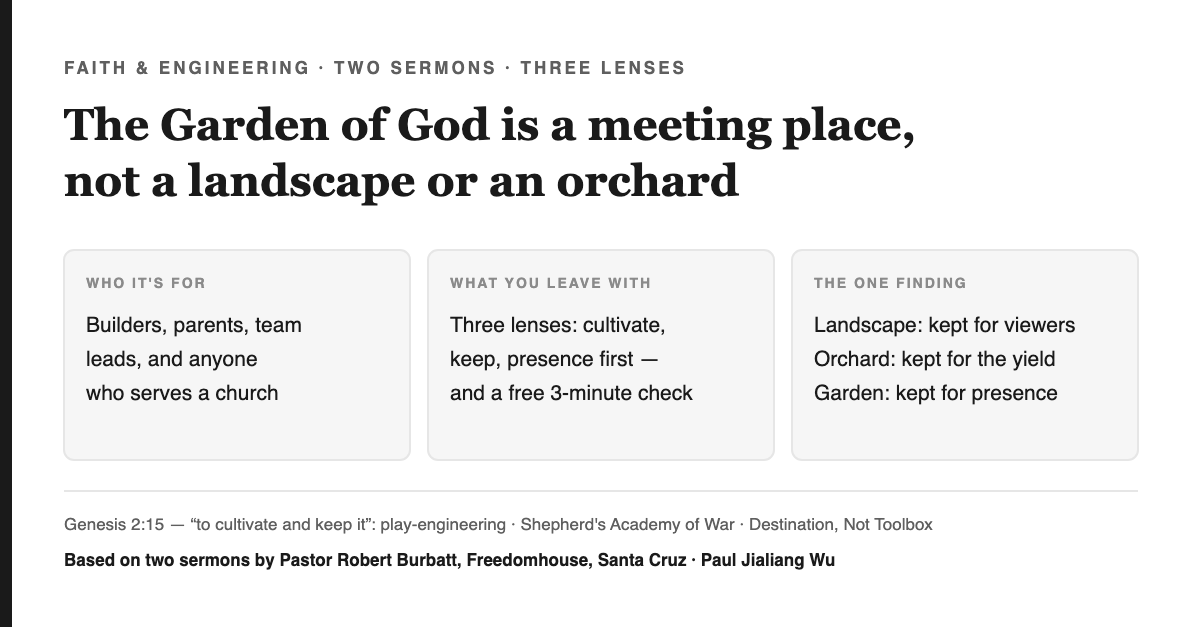
What this is. A long read on the Garden of God, based on two sermons by Pastor Robert Burbatt, seen through three ways of working this site already teaches: play-engineering, a protector's training, and first-principles design. The plain idea: Eden was a meeting place before it was a park, and the man put there had two jobs, to cultivate it and to keep it.
Why it matters. Most of what we care about (a marriage, a child, a team, a product, a church) quietly turns into one of two things. A landscape is kept for the people looking at it. An orchard is kept for what it pays. Both can look healthy for years while the thing that made them alive is gone. Engineers will recognise the failure: optimising a proxy, and swapping the objective for the yield.
What you can do after reading. Run the free Garden Check on one part of your life (3 minutes, nothing leaves your browser), get one move per lens with a date 30 days out, and teach the three kinds of ground to one person this week.
What this piece on the Garden of God covers, and who it's for
On 19 and 26 October 2026, Pastor Robert Burbatt of Freedomhouse in Santa Cruz preached two sermons on the garden: “The Garden: Where God Meets Men” and “The Garden of God: A Pattern Throughout Scripture”. His claim is that the Bible's story is a garden story from end to end. It starts in Eden, redemption happens in Gethsemane and a garden tomb, and it ends with the river and the tree of life in Revelation 22.
This piece reads those sermons with three lenses I already use for engineering and for raising children, each with its own series on this site:
- Play-engineering (the series): play finds the mechanism, engineering tests it on a second case, and the fuel is fascination, not rewards.
- Shepherd's Academy of War (the series): learn the attack so you can live as a protector.
- Destination, Not Toolbox (the series): first principles for agentic work. Fix where you are going, let the route change, and keep the choice human.
The one question this answers: what makes ground a garden rather than a landscape or an orchard, and what does it take to cultivate and keep one? It does not answer how to turn a prophetic vision into a 30-day project (that is Play-Engineering Heaven on Earth), what a tree planted by the water teaches about cost (that is Psalm 1 in Agentic Software Hands You Options), or how fruit is judged (that is Become Good Soil).
It is for builders, parents, team leads and anyone in a church. One lens is my own faith. The engineering in it stands without that belief, and I mark which is which as I go: Sermon for what the pastor said, Lens for my reading, Evidence for research with a source, Open for what nobody has measured yet.
One picture: the dawn walk
One picture will carry the whole piece, so let me introduce it as a tool rather than a story.
Every morning, the pastor says, he walks a park near his home at sunrise and prays. He calls it “my garden place”. Genesis has the same picture at its centre: God walking in the garden in the cool of the day.
“They heard Yahweh God’s voice walking in the garden in the cool of the day, and the man and his wife hid themselves from the presence of Yahweh God among the trees of the garden.”
Genesis 3:8 (WEB)
A garden in this sense is ground where someone keeps showing up to meet someone. Everything else, from the trees to the river to the work, serves that meeting. Here is the picture mapped one to one onto the terms this article uses:
| In the dawn walk | In Eden | The engineering term |
|---|---|---|
| Who you are walking to meet | God's presence, the point of the place | The destination: the objective that everything else is scored against |
| Walking every morning, unhurried | Walking “in the cool of the day” | Free-choice time: time spent with nothing paying you for it, the purest measure of what you love |
| Weeding, watering, pruning | “to cultivate” (Genesis 2:15) | The work loop: try, observe, adjust (play finds the mechanism) |
| Shutting the gate, noticing what got in | “and keep it” (Genesis 2:15) | Guarding: a threat model, tripwires and a gate that fails closed |
| The park you were given, not your neighbour's | “there he put the man” (Genesis 2:8) | The scope: the plot is assigned, not chosen |
| Rain you did not make | “A river went out of Eden to water the garden” (Genesis 2:10) | The source: an input the system needs and cannot produce |
What the two sermons actually say
Six claims carry both sermons. Every quotation below links to the second of the video where it begins, so you can hear it in his voice. A note on accuracy first, because it turned out to matter.
The summary I started from was a landscape. I began with a neat AI-written summary of these sermons: six topics, each with a SMART action plan and a pull quote. It looked professional and polished. Checked against the captions, five of its details were not in the sermons. Mary mistaking Jesus for the gardener and Peter's sword are good Bible stories, but he told neither. He never said the Hebrew words abad or shamar. One “quote” was a paraphrase, and the two videos were listed in the wrong order. Professional, polished, and in five places, not him. So everything here is checked against the tape.
1. Eden was a sanctuary before it was a park. Sermon
“Before there was a temple, there was a garden. Before there was even a priesthood, there was Adam. Before there was a nation that we even call Israel, there was a sacred space called Eden.”
Pastor Robert Burbatt · Part 1, 57:30
His point is that what made Eden Eden was not the scenery. In his words, “the distinguishing feature of Eden was not its trees.” (Part 1, 01:02:01) It was the meeting. He applies the same rule to buildings: “the purpose of the facilities is to accommodate the presence.” (Part 1, 01:01:31)
2. Adam was a gardener-priest. Sermon He calls Adam “Adam was humanity's first gardener priest.” (Part 1, 01:25:32) and explains that the two verbs in Genesis 2:15, work and keep, are later used for priestly service in the tabernacle, so “Adam's task was not merely agricultural. He was a caretaker of a sacred space.” (Part 1, 01:26:00)
“Yahweh God took the man, and put him into the garden of Eden to cultivate and keep it.”
Genesis 2:15 (WEB)
The pairing is checkable in any translation. Here is the same “keep” and “service” describing the Levites at the Tent of Meeting:
“They shall keep his requirements, and the requirements of the whole congregation before the Tent of Meeting, to do the service of the tabernacle.”
Numbers 3:7 (WEB)
Evidence The scholarly form of this reading is Gordon Wenham's “Sanctuary Symbolism in the Garden of Eden Story” (1986), later developed by G. K. Beale. It is a reading, not a consensus. Andrew Perriman has argued that most of the parallels show the temple was built to look like a garden, not that Genesis presents the garden as a temple. I find the pairing of the two verbs persuasive. You should know it is debated.
3. The garden was meant to grow. Sermon The mandate to “fill the earth” meant Eden was a seed, not a fence: “So the garden was meant to expand.” (Part 1, 01:27:30)
4. The fall was a failure of guarding, and the exile was mercy. Sermon
“the first man was both a gardener and a guardian. This is where we see the failure was. He didn't cut the snake's head off.”
Pastor Robert Burbatt · Part 1, 01:26:00
Then the turn I did not expect: “The exile from Eden was not merely a consequence of sin. It was also an act of his protection over us.” (Part 1, 01:30:32) “He drove man from Eden because he was too gracious to allow [fallen] humanity to live forever under the curse.” (Part 1, 01:31:02) The cherubim at the gate are not just a punishment. They stop something that could not be undone.
5. Restoration happens in a garden. Sermon Gethsemane is a garden, and so is the place of the tomb (John 19:41). “Where the first Adam chose his own will, Christ submits to the father's will.” (Part 1, 01:32:30) In Part 2 he follows the image through the prophets, who “The prophets never got over Eden because God never abandoned his purpose” (Part 2, 01:04:31): deserts made like Eden (Isaiah 51:3), the “watered garden” (Isaiah 58:11), and the leaves of the tree “for the healing of the nations” (Revelation 22:2).
6. You can build the wrong kind of ground. Sermon This is the part I have not stopped thinking about.
“Some of you just want to make landscapes. You don't want gardens.”
Pastor Robert Burbatt · Part 1, 01:34:30
“Some of us want orchards. What are orchards? That means you want a god that's transactional because orchards is for commercial purposes.”
Pastor Robert Burbatt · Part 1, 01:35:00
And the line that names the failure: “It's a nice landscape, but there's no presence. It's professional and it's polished, but no presence.” (Part 1, 01:35:31) His prescription comes in two sentences: “You build a garden where God plants you.” (Part 1, 01:39:30), and “Before God gave Adam a task, he gave Adam his presence.” (Part 1, 01:42:31)
Three kinds of ground: landscape, orchard, garden
His three words are more precise than they sound. Each kind of ground is optimised for a different thing, and you can tell them apart by what they measure.
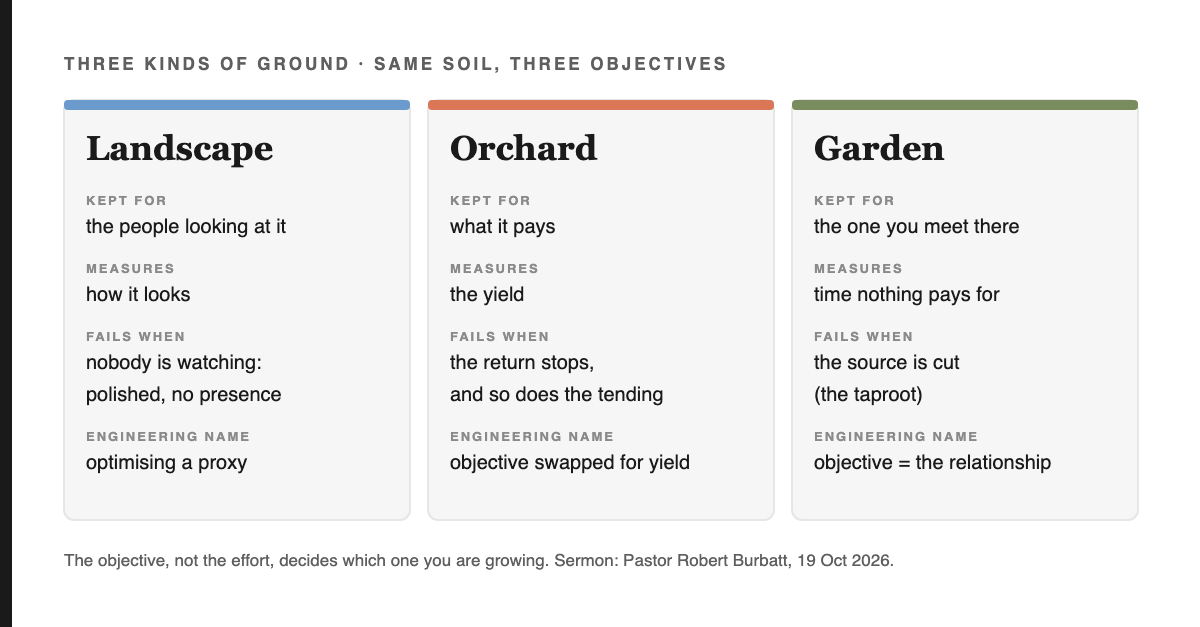
| Landscape | Orchard | Garden | |
|---|---|---|---|
| Kept for | The people looking at it | What it produces | The one you meet there |
| What it measures | How it looks | What it pays | Time spent there that nothing pays for |
| How it fails | Polished, with no presence | The tending stops when the return stops | It goes dry when the source is cut |
| Engineering name | Optimising a proxy (Goodhart's law) | Swapping the objective for the yield | Objective = the relationship. Yield and looks are side effects |
| Which lens catches it | Destination, Not Toolbox | Play-engineering | Shepherd's Academy guards it |
Neither failure is laziness. Landscapers and orchard keepers often work harder than gardeners. The difference is which number they are chasing, which is why I think it is an engineering problem as much as a spiritual one.
Lens 1: play-engineering, where cultivating is play and the orchard drains the fuel
Lens Play-engineering says play finds the mechanism and engineering tests it on a second case, and its second episode asks what keeps a child at something hard for years. The answer was fascination, not scores. That is the same split as the sermon's orchard and garden.
Evidence The strongest number in that episode comes from a meta-analysis of 128 experiments (Deci, Koestner & Ryan, 1999). Expected, tangible rewards for doing a task reduced how much people chose to keep doing it in their free time (effect size d = −0.40). Honest positive feedback increased it (d = +0.33). The reward was not neutral. Paying for the activity taught people the activity was work.
Lens That is the orchard, measured. Tend a marriage, a child or a church for what it pays you, and you train yourself to stop showing up when it doesn't. “Sounds like you had an orchard, not a garden.” (Part 1, 01:38:01) The garden's measure is the one play-engineering already uses: free-choice minutes. How much time did you spend there this week when nothing was paying you to be there?
Two more things from the play lens:
- The taproot. Sermon The pastor tells of a potted fig tree whose root had grown out through the drain hole. He cut it so he could move the pot, and it died overnight. “So, memo to self. Know where you're going to put this before you actually plant it.” (Part 1, 56:31) In play-engineering terms, he cut the source to make the toy portable. Every “let's make this more efficient” plan for a relationship should ask which root it is cutting.
- Presence before task is fascination before score. “Before God gave Adam a task, he gave Adam his presence.” (Part 1, 01:42:31) The play series made the same argument for children: give the vivid future self first, and then the drills. Reverse the order and the drills shrink the fuel.
Lens 2: Shepherd's Academy of War, where keeping is guarding and the guard failed first
Lens The second verb, keep, is a guard's word. Shepherd's Academy of War exists for exactly this job: learn the attack, live as a protector. Its first law is that people are never the enemy, which suits the pastor's complaint that Adam “the first man was both a gardener and a guardian. This is where we see the failure was. He didn't cut the snake's head off.” (Part 1, 01:26:00) A snake, notably, is not a person. Law intact.
So what was the attack? Read it the way a security engineer reads an incident report.
“Now the serpent was more subtle than any animal of the field which Yahweh God had made. He said to the woman, “Has God really said, ‘You shall not eat of any tree of the garden?’””
Genesis 3:1 (WEB)
Lens The first attack in the Bible is a prompt injection. It does not argue with the instruction. It rewrites the instruction and asks the target to confirm the rewrite. Now put the original instruction next to how it was repeated back:
“Yahweh God commanded the man, saying, “You may freely eat of every tree of the garden; but you shall not eat of the tree of the knowledge of good and evil; for in the day that you eat of it, you will surely die.””
Genesis 2:16-17 (WEB)
“The woman said to the serpent, “We may eat fruit from the trees of the garden, but not the fruit of the tree which is in the middle of the garden. God has said, ‘You shall not eat of it. You shall not touch it, lest you die.’” The serpent said to the woman, “You won’t really die,”
Genesis 3:2-4a (WEB)
Lens The spec had already drifted before the attack landed. “Freely eat of every tree” has lost its “freely”, and a new rule has appeared: “You shall not touch it.” Adam received the command in Genesis 2, before Eve was made, so the instruction reached her second-hand. Whoever relayed it, the guard's job included keeping the words intact. An attacker's best opening is a rule that is already slightly wrong. Make it stricter than it was and the giver looks stingy. Then the attacker supplies the generous version: “You won't really die.” “The guardian failed to guard.” (Part 1, 01:28:31)
Shepherd's Academy turns that into drills, and three of them apply here directly:
- Know the rule word for word. Most of what a guard needs is to notice a misquote. It is also why every verse in this article is diffed against its source before it ships.
- A gate that fails closed is mercy, not cruelty.
In system terms, the cherubim block one irreversible action: eating from the tree of life in a fallen state and staying that way forever (Genesis 3:22). The pastor calls it “The exile from Eden was not merely a consequence of sin. It was also an act of his protection over us.” (Part 1, 01:30:32) An engineer calls it a hard limit, and the reason you add one is to prevent the state you cannot roll back.“So he drove out the man; and he placed cherubim at the east of the garden of Eden, and a flaming sword which turned every way, to guard the way to the tree of life.”
Genesis 3:24 (WEB)
- Rehearse before the fight, so you respond instead of react. In Gethsemane, an angel strengthened Jesus before the arrest (Luke 22:43). “Peter's reacting. Jesus is responding.” (Part 2, 01:12:31) “Most of us are always reacting in our Christian life because we don't know how to respond because we haven't received strength.” (Part 2, 01:12:31) SAW's fourth drill move is literally “Rehearse” (the scorecard episode). In control terms, strength received before the event is feedforward. Reacting is a controller with nothing but feedback, always one step late.
Lens 3: Destination, Not Toolbox, where presence is the destination and stewardship is the route
Lens The first principle of Destination, Not Toolbox is to fix where you are going and let the route change. The pastor's version is shorter: “Never separate stewardship from communion with God.” (Part 1, 01:43:00)
Read it as a design rule. Communion is the destination: the objective every other decision is scored against. Stewardship is the route, meaning the budget, the calendar, the chores and the programme. Separate them and you get his two failures exactly. Score stewardship by how it looks and you have a landscape. Score it by what it returns and you have an orchard.
His diagnostic is the best debugging advice in either sermon:
“The more I see your stewardship out of order, it's usually because you got a communion problem.”
Pastor Robert Burbatt · Part 1, 01:43:00
Lens Every engineer has fixed a bug in the wrong layer: patching the symptom in the UI when the data model was wrong. Stewardship out of order is the symptom layer. Communion is the model. Fix the calendar and the disorder comes back. Fix the meeting and the calendar tends to follow.
Two more first principles from this series map cleanly:
- The plot is a given, not a variable. “You build a garden where God plants you.” (Part 1, 01:39:30) In the language of the options article, that is max-calling, min-cost: the calling is the ground you were put on, and everything else should cost as little as possible. His warning about “people become busy bodies in gardens that aren't theirs to tend.” (Part 2, 52:30) is an optimiser chasing someone else's objective. It will report great numbers for a plot it does not own.
- Keep the loop running after you ship. OEC loops observe, evaluate and control at every scale. For a garden that is an ordinary week: notice what grew, check it against what you meant, and change one thing. The prayer closet of Matthew 6:6 is the observation step with the noise removed: “even a still small voice will be loud in a place of intimacy.” (Part 1, 01:44:32)
“But you, when you pray, enter into your inner room, and having shut your door, pray to your Father who is in secret, and your Father who sees in secret will reward you openly.”
Matthew 6:6 (WEB)
Where engineering stops: the increase is not ours
Here is the tension I owe you. This site loves ratchets: measure, set a floor, raise it, never let it fall. The pastor is blunt about what that cannot do:
“You're not a self-improved caterpillar. You're a new creature in Christ.”
Pastor Robert Burbatt · Part 2, 01:03:00
“Spiritual flourishing is not merely the result of human effort. It is the result of divine nurturing.”
Pastor Robert Burbatt · Part 2, 01:09:02
Lens I think he is right, and the line between the two is clean. Engineering can measure and improve the tending: the minutes, the guarding, the rehearsal. It cannot produce the growth, the same way a gardener cannot produce rain. Paul said it about his own work:
“I planted. Apollos watered. But God gave the increase. So then neither he who plants is anything, nor he who waters, but God who gives the increase.”
1 Corinthians 3:6-7 (WEB)
The pastor said it about his own church: “God's the one who has to bring increase.” (Part 1, 01:40:30) The Truth, Love, Beauty episode reached the same edge from the engineering side. A system that feeds itself still needs a steady source it cannot generate. The ratchet measures the gardener. It never takes credit for the garden.
Open Is that the right line? The test is simple. If people who track tending (free-choice minutes, guard checks) report no more life in that part of their lives after 30 days than people who don't, the tending metrics are decoration, and I will say so in a dated update to this page.
Five whys: why a well-kept life still goes barren
- Why is this part of my life dry when I work hard at it? Because the work is aimed at looks or yield, not presence.
- Why is it aimed there? Because looks and yield are visible and measurable, and presence is not. We optimise what we can see.
- Why can't I see presence? Because nobody measures it. No one counts the unhurried, unpaid time spent there.
- Why doesn't anyone count it? Because tasks crowd it out. Stewardship got separated from communion, and the task list won.
- Why did the task list win? Because the source was assumed instead of protected. The taproot was cut to make the pot portable. Root cause: the objective was never written down as “the meeting”, so every efficiency looked free.
Operate, feedback, feedforward
Operate: a thing that runs. The Garden Check is a small page you can open now. Name one part of your life (a marriage, a child, a team, a product, a ministry) and answer seven statements: two for landscape, two for orchard and three for garden (presence, cultivate, keep). Then enter your free-choice minutes for the week. It tells you which ground you are mostly tending, gives one move per lens, and dates a re-check 30 days out. Nothing leaves your browser.
Feedback: the measurement, and what it can't see. Two numbers, weekly. First, free-choice minutes in that sphere. Second, one guard check: did you notice something getting in, and did you deal with it early? What these cannot see is the thing that matters most: whether anything grew. That is why the Check asks for a one-line note in your own words, not just a number. A metric that claims to measure the garden is a landscape.
Feedforward: tripwires I commit to now.
- If my free-choice minutes in a sphere are zero two weeks running, that sphere has become a landscape or an orchard. I change the calendar before I change anything else.
- If I catch myself reporting a sphere's yield (“the team shipped”, “the kids got As”) when asked how it is, I have swapped the objective. I ask the question again about the meeting.
- If a planned efficiency removes the time I spend with someone, it is the taproot. It does not ship without a replacement for that time.
- If I quote a rule from memory in an argument, I look it up first. Spec drift is where the serpent starts.
Same story, five exits
| If you are a… | The decision | One action this week |
|---|---|---|
| Student | Is this subject a landscape (grades for viewers) or a garden (something you would do unpaid)? | Log your free-choice minutes on it for 7 days. |
| Engineer | Which metric on your dashboard is a landscape, measuring the look of the thing rather than the thing? | Write down the objective it stands in for, in one sentence. |
| Founder | Are your first users a garden (you meet them) or an orchard (you harvest them)? | Spend one unpaid hour with three of them, with no demo. |
| Executive | Where did stewardship split from communion in your org: the budget review without the people? | Fix one problem in the right layer, not the symptom. |
| Parent or pastor | Which of the ones in your care get presence, and which get programmes? | One closed-door, 20-minute time with one of them, nothing to accomplish. |
Build it in 30 minutes
The Garden Check is small on purpose. To build your own (for a team, a class or a small group):
- Inputs: one named sphere; seven statements scored 0, 1 or 2 (two landscape, two orchard, three garden); free-choice minutes this week.
- Output: three percentages, the dominant kind of ground, one move per lens, and a re-check date of today + 30 days.
- Invariant: the garden score can never be raised by looks or yield answers. The three scales are computed separately and never added.
- Stop rule: one sphere per run. A check over your whole life becomes a landscape of a check.
- Deliberately missing: accounts, sharing and a leaderboard. Each would turn the tool into an orchard, or into a landscape for viewers. If you want to share, copy your result as a comment on this article.
Now teach it
Learning by teaching is the fastest way to find out if you understood. This week:
- Run the Garden Check on one sphere. Write your free-choice minutes and the one move down.
- Teach the three kinds of ground to one person in under two minutes, using one question: “Who is this kept for: the viewers, the yield, or the one you meet there?” Let them pick their own example.
- Come back and leave a comment with the sphere, your minutes and your re-check date. A comment with a number in it is a data point, and the next update of this page will count them.
5S self-score, with the evidence for each row
| S | Score | Evidence |
|---|---|---|
| Simple | 4/5 | One picture (the dawn walk) pinned 1:1 in a table; one question; three words a 15-year-old can repeat. Not yet tested on a real 15-year-old, so not 5. |
| Solid | 4/5 | Every scripture is WEB, diffed against bible-api.com by --verify-scripture. Every sermon quote is checked against the caption track by --verify-quotes and links to its second of video. The sanctuary reading carries its critic. Captions are machine-made, so a quote may carry a mis-heard word; corrections are in [brackets]. |
| Sharp | 4/5 | Named mechanisms: proxy optimisation (landscape), reward undermining d = −0.40 (orchard), spec drift then injection (the fall), fail-closed gate (the cherubim), feedforward (Gethsemane). Root cause stated in the five whys. |
| SMART | 4/5 | One sphere, one number (free-choice minutes), one move per lens, a re-check date of today + 30 days, built into the Check. Whether 30 days is long enough to see growth is OPEN. |
| Surprise | 3/5 | The first attack is a prompt injection; the snake is not a person, so the law holds; my own starting summary was the landscape. No belly laugh yet, so 3. |
Sources and provenance
- Pastor Robert Burbatt, Lead Pastor, Freedomhouse (Santa Cruz, California). Part 1, “The Garden: Where God Meets Men”, 19 October 2026; Part 2, “The Garden of God: A Pattern Throughout Scripture”, 26 October 2026; channel FreedomhouseUS. Quotations are from YouTube's auto-generated caption track at the linked second; punctuation and casing are mine, and [brackets] mark a corrected mis-hearing. The interpretations marked Lens are mine, not his.
- Scripture: World English Bible (public domain), fetched from bible-api.com. In the translated editions of this page, verses are rendered by the translation pipeline from the WEB. They are not the 和合本, 개역개정, 新改訳 or Reina-Valera, and should not be cited as those.
- G. J. Wenham, “Sanctuary Symbolism in the Garden of Eden Story”, Proceedings of the Ninth World Congress of Jewish Studies, Division A (1986). Described, not quoted. Critique: A. Perriman, “Was the garden of Eden an ‘archetypal sanctuary’?” (2017).
- E. L. Deci, R. Koestner & R. M. Ryan, “A meta-analytic review of experiments examining the effects of extrinsic rewards on intrinsic motivation”, Psychological Bulletin 125(6), 627–668 (1999), doi:10.1037/0033-2909.125.6.627. Effect sizes as reported in Play-Engineering, episode 2.